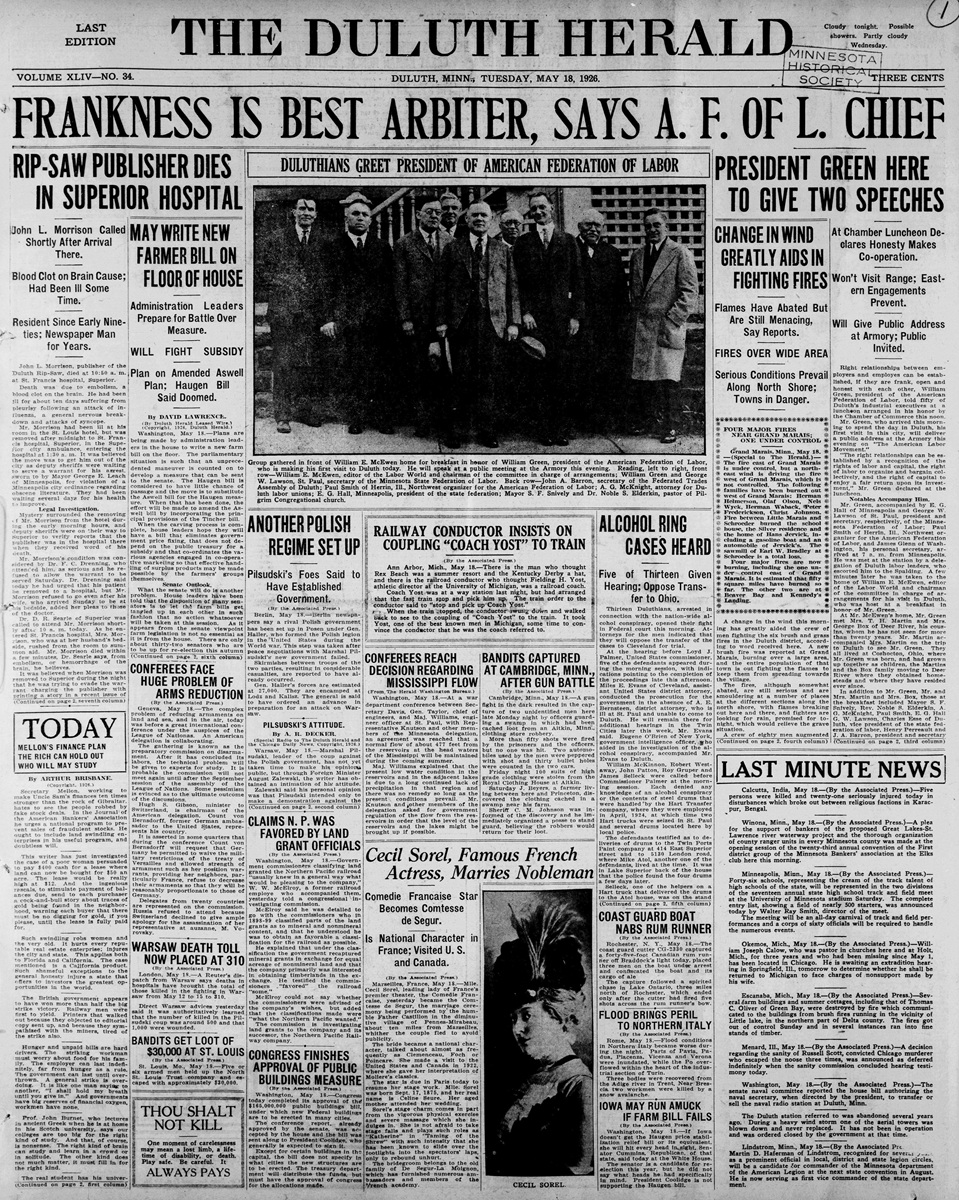
Rip-saw publisher John L. Morrison died in 1926
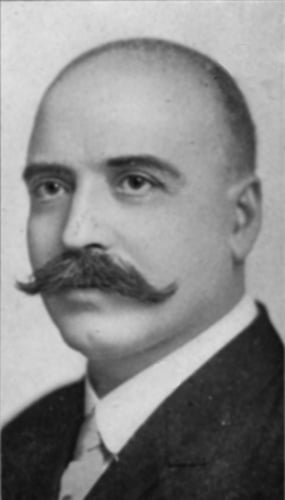
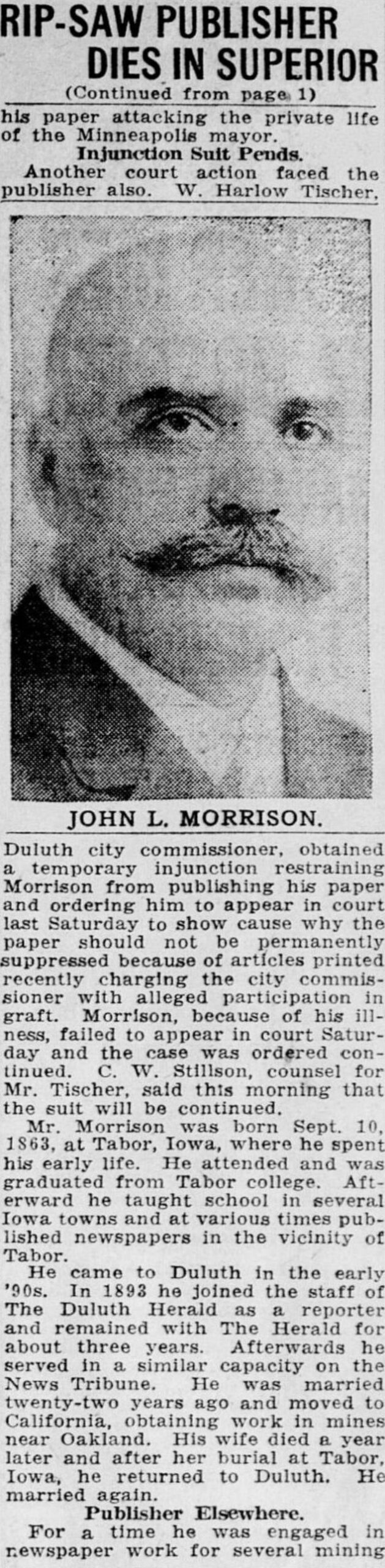
Newspaper publisher John L. Morrison died 100 years ago today — May 18, 1926. As “head sawyer” of the Duluth Rip-saw, he was known for his unrelenting attacks on local politicians, which led to a gag order that shut his publication down. Five years after his mysterious death at the age of 62, Morrison was vindicated by the U.S. Supreme Court, which ruled the Public Nuisance Law violated the First Amendment of the United States Constitution protecting the freedom of the press.
The Ripsaw returned in 1999 (minus the hyphen) as an alternative news and arts newspaper, and continued until 2005. The following account of Morrison’s story is excerpted from the article “Ripsaw turns 85,” published in March 13, 2002 Ripsaw. It draws heavily from old newspaper accounts and the 1981 book Minnesota Rag: The Dramatic Story of the Landmark Supreme Court Case That Gave New Meaning to Freedom of the Press by Fred W. Friendly. It is also the foundation of the John L. Morrison Wikipedia entry.
The Rip-saw debuted on March 24, 1917, with Morrison producing the biweekly scandal sheet almost entirely by himself during its 9-year run.
“The Rip-saw is a genuine one-man sawmill,” Morrison wrote in the July 13, 1918 editorial. “The entire work, snaking out dead-heads, filing the saw, piling the product, getting it to the market, even loading and billing it, falls on one man. It often takes 18 hours a day and seven days a week to do all that half way creditably, to say nothing of brilliantly.”
Morrison fought for streetcars, public toilets and higher pay for policemen. He railed against alcohol, prostitution and gambling. His specialty was digging into the “unholy and undesirable alliance” between lawmakers and lawbreakers. During the Rip-saw’s first year, Duluth Chief of Police Robert McKercher and City Auditor “King” Odin Halden were both ousted from their positions after being labeled crooked in the paper.
Morrison’s downfall began with the Oct. 25, 1924 Rip-saw. He accused State Senator Mike Boylan of threatening him with mayhem and death, Cass County Probate Judge Bert Jamison of having acquired syphilis at a brothel, and Victor L. Power, a former mayor of Hibbing, of corrupt legal practices and a weakness for women and whiskey. All three retaliated.
Morrison was quickly arrested by a sheriff from Walker, about 115 miles west of Duluth, on charges of criminal libel brought by Jamison. Numerous affidavits from hospitals and doctors indicated Jamison’s 12 recent surgeries were all due to glandular troubles caused by tuberculosis, not syphilis. But Jamison never denied he visited a brothel.
Morrison was tried on Oct. 30, 1924 and sentenced to 90 days in the Cass County jail. He raised bail and returned to Duluth pending appeal. Alfred Lambert, the source of Morrison’s story, was also tried for slander and criminal libel, and sentenced to 30 days in the county jail.
At the same time Morrison was seeking to raise the bond in Cass County, Power was bringing forth criminal and civil libel actions, claiming the Oct. 25 Rip-saw article was written for the sole purpose of injuring him politically. A warrant for Morrison’s arrest was in the hands of Duluth Police awaiting his release from the Cass County jail.
Power was seeking the Eighth Congressional District seat, and Morrison accused him of taking money from undesirable clients, then abandoning them. He also quoted Mesabi Hotel employees who told him Power had one night “crawled into bed so beastly drunk … that he used his couch as a privy or puking place entirely without the help of cathartic or emetic.”
Power told the Duluth News Tribune he was going against the advice of his campaign committee by bringing up the charges against Morrison before the election. He alleged the Rip-saw article was “instigated by the opposition camp,” and that Morrison was the advertising manager of his opponent. Furthermore, he suggested that Morrison was “preparing extra copies of his paper to be delivered to the opposition for special circulation.” Power vowed to have anyone who circulated the Rip-saw arrested, saying those who circulate the paper “are as liable to the same prosecution as the publisher.”
Power lost the congressional election and sued Morrison for criminal libel. The trial began on Dec. 3, 1924. State Representative George Lommen was the first to take the witness stand on Power’s behalf. Lommen was no doubt eager to testify against Morrison, who had accused him in the past of collecting bribes from the operators of slot machines, as well as declaring he was such a flip-flopping “political chameleon,” he would probably end up a Communist. Lommen accused Morrison of bringing forth the libelous attacks because he and Power had not bought enough political advertising in the Rip-saw.
Morrison’s trial was the longest in Hibbing history at the time. In the end, after five hours of deliberating, the jury found Morrison guilty. He was sentenced to 90 days in the county workhouse. He immediately appealed.
On June 1, 1925, Morrison was ordered to make a public apology to Power. Morrison told the court and Power that he was sorry if the Rip-saw “had cost Mayor Power the election.” The charges against Morrison were dropped and his sentence rescinded.
Later that month, Morrison pleaded guilty to the charges of criminal libel brought by Jamison. Judge W.S. McClennehan reduced the sentence to a $100 fine, which so pleased Morrison that he attempted to make a speech thanking the judge. McClennehan pounded his fist on his desk and admonished Morrison. “I don’t think any more of you, sir, than I do this damn desk,” he shouted.
The most powerful blow to the Great Family Journal came in the summer of 1925. Senator Boylan, who, according to the Oct. 25, 1924 Rip-saw, had threatened to kill Morrison, now was threatening to kill the precious Freedom of the Press Morrison so frequently exercised.
Boylan worked with Lommen to draft several bills that would allow the suppression of scandalous newspapers. Senator Freyling Stevens, a powerful lawyer, introduced and is credited as the author of the senate version of what would become known as the “gag law.”
The Public Nuisance Bill of 1925 was soon-after approved by the Minnesota State Senate and House. The final joint senate-house bill begins:
Be it enacted by the Legislature of the State of Minnesota:
Section 1. Publication of certain newspapers declared nuisance. — Any person who, as an individual, or as a member or employee of a firm, or association or organization, or as an officer, director, member or employee of a corporation, shall be engaged in the business of regularly or customarily producing, publishing or circulating, having in possession, selling or giving away, (a) an obscene, lewd and lascivious newspaper, magazine, or other periodical, or (b) a malicious, scandalous and defamatory newspaper magazine or other periodical, is guilty of nuisance, and all persons guilty of such nuisance may be enjoined, as hereinafter provided … In actions brought under above, there shall be available the defense that the truth was published with good motives and justifiable ends.
The law allowed a single judge, without jury, to stop a newspaper or magazine from publishing.
Governor Theodore Christianson quietly signed the Public Nuisance Law, and the stage was set for the final showdown.
Morrison remained oblivious. On April 6, 1926, the Rip-saw attacked Minneapolis Mayor George Emerson Leach: “Minnesotans do not want loose-love governor.” In the next issue, Duluth Commissioner of Public Utilities W. Harlow Tischer was the target: “Tischer and his gang fail to establish graft plan.”
Morrison was served with a warrant for his arrest based on a complaint from Leach under an obscene-literature ordinance recently rushed through the Minneapolis City Council.
The next day, a temporary restraining order was placed on the Rip-saw by State District Judge H.J. Grannis of Duluth. Tischer had claimed that the charges of graft were untrue and he demanded the Rip-saw be stopped. The Finnish Publishing Company, which printed the Rip-saw at the time, was also named in the injunction, and news dealers and newsboys were barred from distributing the paper.
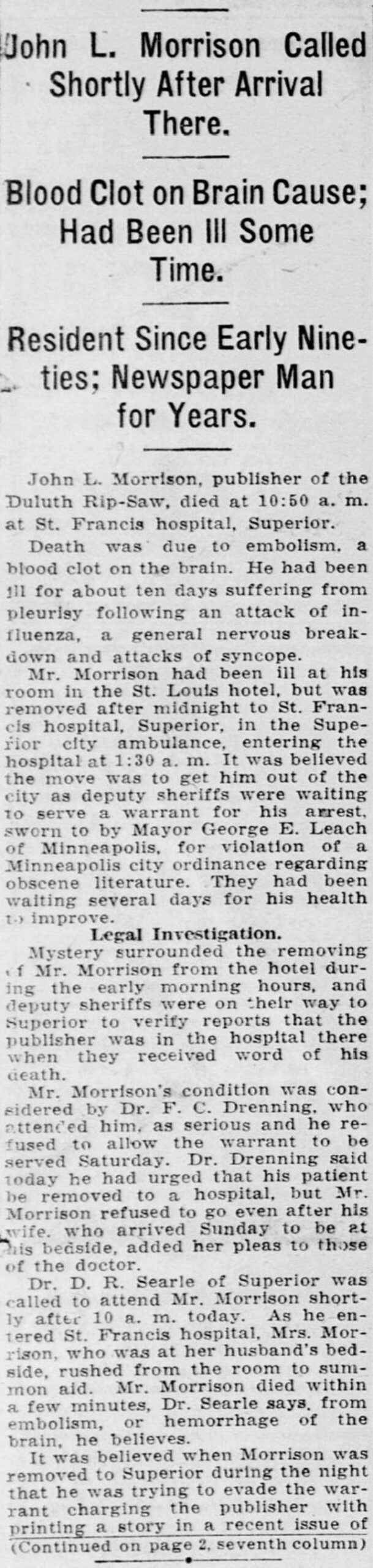
What would have been Morrison’s most important trial of all was set for May 15, 1926. When that day came, however, Morrison did not appear in court. He was strangely ill. Three days later he was rushed to St. Francis Hospital in Superior at around 1 a.m. Nine hours after that, he was pronounced dead. The cause was reported in the Duluth Herald to be an embolism, a blood clot on the brain. The Herald reported that Morrison “had been ill for 10 days, suffering from pleurisy following an attack of influenza, a general breakdown and attacks of syncope.”
An article in that days’ Duluth News Tribune, “Mystery clouds Morrison’s ‘ride’ into Wisconsin,” was written before Morrison’s death. It reported Morrison was carried from a room in the St. Louis Hotel, where he had been living, to an ambulance which belonged to the city of Superior.
At 1:30am attaches at St. Francis Hospital in Superior reported that they had then received a patient, whose name was not learned. The description hospital attendants first gave, that of a ‘big man with a big black mustache,’ was later found to be that of Morrison.
At the Superior police headquarters, early this morning, it was stated that they had received no official authorization for the sending of the ambulance here to bring Morrison to that city.
Sheriff Magie’s forces, in whose hands is the warrant for Morrison’s arrest, could shed no light on the case, and apparently no effort was made to intercept the ambulance and interfere with the transfer of the wanted man across the state line. Duluth Police, likewise, could not explain the move.
Just what appears to be the nature of Morrison’s supposed aliment could not be learned. Neither the ambulance attendants nor St. Francis Hospital attaches could explain what diagnosis had been determined or how serious his condition was.
When Morrison was taken from the St. Louis Hotel to the street, where the ambulance awaited him, his body and face were completely covered by a sheet, it was learned. When the ambulance passed over the interstate bridge into Wisconsin territory, the sheet had been lifted from Morrison, exposing his face to full view, according to the toll collector who inspected the vehicle.
When the ambulance attendants returned to Superior police headquarters after having removed their patient to St. Francis, they denied when questioned by a
reporter that their patient was Morrison. L.K. Bardwell, the ambulance attendant, told the reporter that his patient was a woman.
An article in the following days’ News Tribune noted that “the mysterious departure of Morrison from Duluth early Tuesday morning to Superior was believed to be a ruse to escape arrest, though his condition was serious at that time, physicians reported.”
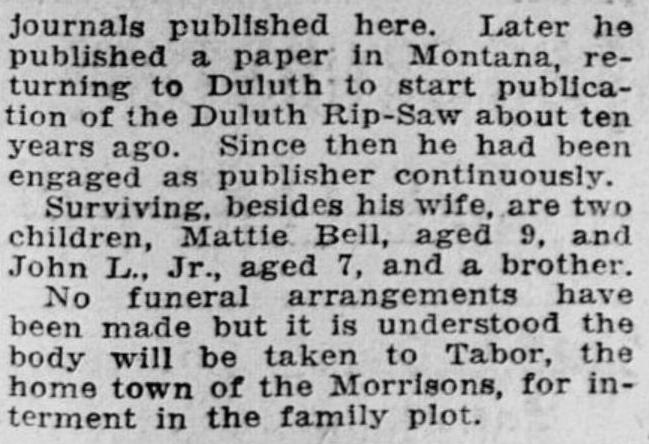
Morrison’s funeral at Bell Brothers Mortuary in West Duluth was well-attended. Mayor Samuel Snively and City Commissioner W.S. McCormick eulogized Morrison as a good man. His body was sent back to his birthplace, Tabor, Iowa.
Tischer continued to insist the injunction against the Rip-saw be maintained, even after Morrison’s death. Judge E.J. Kenney, however, allowed a continuation of the paper “without the articles objected to by Commissioner Tischer.” But it was too late, the head sawyer was no more.
In 1931 the gag law was challenged by Jay Near, publisher of the Saturday Press in Minneapolis. The Supreme Court ruled the law violated the First Amendment of the United States Constitution, which protects the freedom of the press.