

Sir Duluth Historical Timeline
 Daniel Greysolon, Sieur du Luht, was an influential French explorer whose name anglicizes to Sir Duluth. He signed his letters “Dulhut,” participating in his own casual anglicization despite the constant conflict his nation had with England. I call him Duluth, synonymous with our present-day, American city, whose name he inspired.
1639: Duluth is born in Saint-Germain-Laval, France.
1650: Duluth is 11 when the first modern philosopher René Descartes dies age 53 in Stockholm, Sweden. A letter from the young Duluth lies on the bedside table, offering a common-sense critique of Descartes’ notion that animals are automatons who may be vivisected. “I guess you’ve never owned a pet,” the boy’s careful handwriting says. The letter continues, “‘I think therefore I am’ is meaningless since grounds for doubting existence do not exist. You torture language like you torture dogs.” It has been suggested that Descartes was so distressed to have his life’s work effortlessly eviscerated by a child that he quickly succumbed to pneumonia and died.
1657: 18-year-old Duluth thrills as the unpublished work of the duelist and science-fiction pioneer, the late Cyrano de Bergerac, posthumously drops. Devouring Empires of the Moon, Duluth’s fancy is filled with the depiction of explorers blasting into space and aliens with talking earrings.
1660: Duluth, a soldier at 21, goes undercover in the Dutch Republic, to the city of Delft. He is on a mission for the French king to find and destroy a massive reserve of gunpowder. The mission is a failure as the gunpowder has been safely outside the city since 1654. But Duluth meets master painter Johannes Vermeer, age 28, and they develop a forbidden friendship transcending the political friction between their nations. In addition to coaching Duluth’s barely-adequate Dutch vocabulary, Vermeer teaches him the secret of light: “Light does not reveal objects — objects reveal light.” In return, Duluth purchases a lens-based scientific painting aid — a camera obscura, to reveal the light — and permanently loans it to Vermeer.
1673: Duluth is 34 at the Siege of Maastricht during the Franco-Dutch war. He fights back-to-back with the famed musketeer Count Charles d’Artagnan, age 62. The musketeer’s reputation precedes him, even though he will not be immortalized in the Three Musketeers novels for another 75 years. In between tactical actions, d’Artagnan teaches Duluth a trick fencing move from deep in the treatises. “It will put you a move ahead,” he says, “if you use your scabbard for your first parry, instead of your rapier. To begin, you must carry your scabbard, not wear it. But no one expects this maneuver, especially if the scabbard is a nice one, like mine.” D’Artagnan demonstrates the technique with his jewel-encrusted velvet-lined gold scabbard. Then he is shot by a sniper with a musket ball in the throat. He dies in Duluth’s arms.
Later that summer, Duluth threads a schooner through the chaotic naval engagement at the Battle of Texel. His mission is to seize or destroy spice ships that are using the battle for cover to scurry into Dutch harbors. He isolates a straggler and blasts her masts, scent of cardamom mixing with gunpowder. Fallen rigging interferes with the firing of the spice ship’s deck cannons. Coming alongside, Duluth smells anise as his men lash the schooner to her, and board clashing. The wind shifts during the long melee; an unmanned English fireship, having missed its initial target, bears down on them.
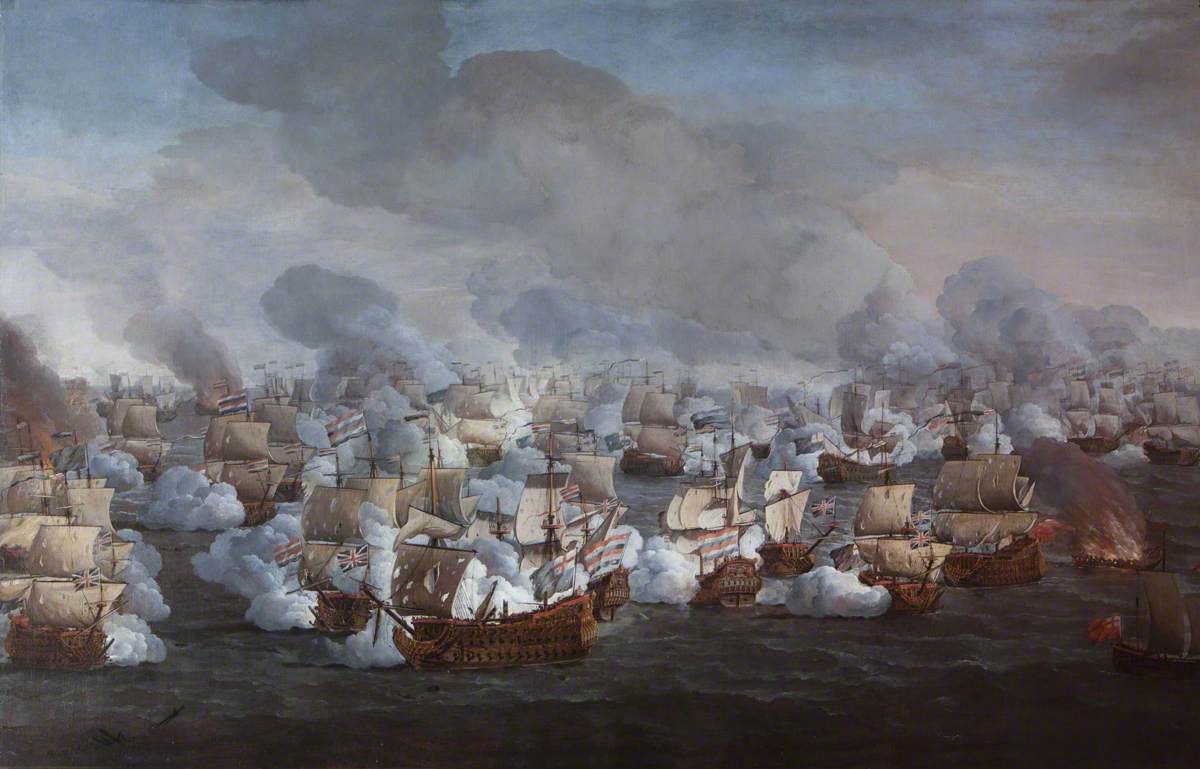
The Battle of Texel. A combined French and English force tries blockading Holland but a smaller Dutch force sends them packing, aided by the French and English hating each other. The French laugh it off and are even a little thrilled by the sheer Dutch competence; the English seethe about it: “The French are incapable of not getting drawn off into long chases while we get pounded in the center.” (Painting by Willem van de Velde I, 1673)
Duluth orders a full retreat from the three-sided conflict. This fireship is about to do his job for him but he’s got to leave five minutes ago. The spice sailors realize the fight must turn from repelling the Frenchmen, to preventing them from leaving — so that everyone will die together. Cutting the grapple lines takes too long in the frenzy and Duluth slips the schooner away with little time to spare. The spice sailors scatter but there is no place to go.
The fireship tears into the spice ship. The spreading blaze races the ingress of water to see which element can destroy the ship first. Hundreds of wooden barrels in the hold catch fire and detonate from the volatile oils powering spice fragrances. Black, white, and red peppercorns pop off like firecrackers, the air burning in bright colors with flammable powders of turmeric, lemon peel, and mace. The sea belches cinnamon as the spice ship sinks, taking the fireship with it.
But Duluth can’t enjoy himself, later writing, “I’m a good soldier but as an explorer I could’ve ended the war by sailing west, finding the back door to the spice islands. Instead of trying to capture their ships, we should have been trying to capture their markets.” Consoling himself after the battle — the smaller Dutch force had completely outclassed the French and English as usual — he invents a new cocktail: “Brandy infused with fresh raspberries for six weeks or until blood red, dash of vanilla extract, grated smoked black pepper, garnish with flamed citrus peel. I call it the Duluth Fireship. Vive la France!”
1675: When Duluth is 36, the 43-year-old Vermeer has a stroke and lies on his deathbed in Delft. By coincidence, Duluth is already in town disguised as a Dutchman. He is putting off seeing his friend while he purchases two lenses from Antony van Leeuwenhoek, the father of microbiology who sold him the camera obscura 15 years ago. Van Leeuwenhoek mentions Vermeer is dying as an aside; Duluth rushes over. At Vermeer’s bed Duluth says, “Remember when I told you to use more blue? And that you should paint more seascapes? Vermeer means ‘of the sea’ anyway.” Vermeer whispers a correction: “‘Of the lake’” — his last words. The house erupts with the wailing of eleven children. Duluth thinks, “No wonder he didn’t paint more.” The secret Vermeer takes to his grave is that in 1673, he had been mustered into the Dutch militia as a sharpshooter in response to the French invasion, and it was his musket ball that killed d’Artagnan at the Siege of Maastricht. Duluth repossesses his camera obscura as he leaves the Vermeer death house; Vermeer’s biographers forever wonder where it went, since they know the master used one, but it fails to appear in an inventory of his possessions.
1676: In Saint-Étienne, Duluth fits his lenses into optical instruments. Studying protozoans in water, he looks away from the microscope to write, “A raindrop to these beings is like the whole of Paris.” He examines his own seminal fluid and fecal matter. He retrieves the telescope he made from the second lens and points it at Saturn. Counting its rings, he wonders about being so insignificant, and yet at the center of it all. “Galileo would’ve killed for this lens,” he writes.
1678: Duluth, age 39, sails west from France to Montreal in New France. Then he sails west on Lake Superior until he runs out of lake. This is the future site of Duluth, Minnesota.
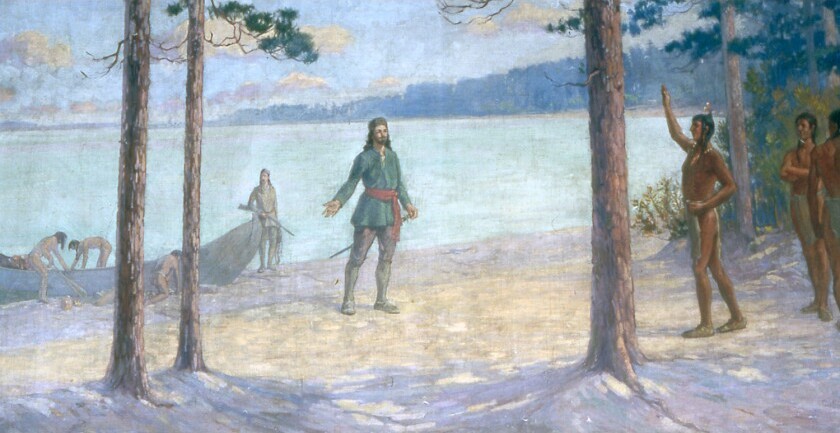
Duluth “discovers” Park Point. His mission from the French king: to steal the lucrative beaver pelt market from the English by convincing the Dakota and Ojibwe to trade with France instead. The mission is a success. He keeps hoping he might find the Pacific Ocean around here somewhere. That mission is not a success. (Painting by C.C. Rosenkrantz, 1919)
1680: Duluth rescues Father Louis Hennepin from the frontier.
1681: Duluth travels back to France to defend himself against trumped-up allegations by business competitors.
1682: Returning to Montreal, the 43-year-old Duluth gets challenged to a street duel by someone who doesn’t believe he was just cleared of all charges. Duluth draws his rapier from his red leather and maple wood scabbard. His opponent slashes to create openings for a thrust. Duluth parries — his opponent’s blade bites into the thick leather and hard wood, but not all the way through. In fact it sticks for a second. Duluth knows he should lunge with a stab, but in the heat of battle he’s got the sun in his eyes. He brings his blade down wildly from over his head to split his opponent’s skull. The sword connects but glances off the opponent’s wide-brimmed leather hat. Duluth had started one move ahead, but now he is down two. He finds himself skewered through the abdomen, his scabbard falling in two pieces to the ground. But now the opponent is in close. Duluth whips his blade into a pulling cut across the opponent’s neck. Duluth has won but lies bleeding out. Or so he thinks. “I wish to return instantly to Lake Superior and the sand beach at its Western shore …” Duluth makes a full recovery.
1710: Age 69, Duluth is dying of gout in Montreal. The fact does not surprise him; he’d identified telltale uric acid crystals in his blood and urine back in 1676. Duluth sends the first scientist / last alchemist Sir Isaac Newton, aged 67, a letter: “Congratulations on inventing calculus, Leibniz is a fraud.” Duluth dies.
1711: Newton accuses Leibniz of being a fraud.
An index of Jim Richardson’s essays may be found here.