

Duluth Deep Dive #9: The Third Largest City in Minnesota
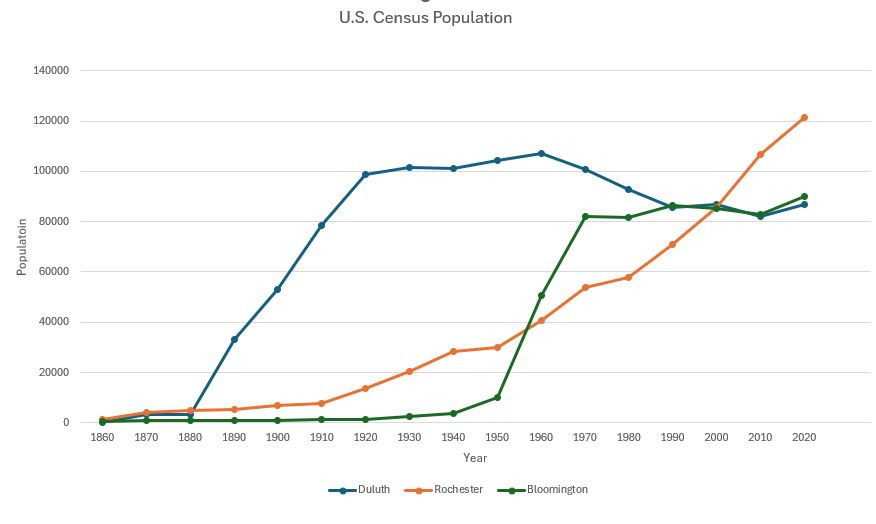
The population of Duluth, Bloomington, and Rochester over time (Source: U.S. Census Data)
A recent YouTube video on Duluth restaurants described Duluth as the third-largest city in Minnesota — a statement that has been true at various points in the state’s history. Since Minnesota became the 32nd state in 1858, Minneapolis and St. Paul have consistently been its two largest cities. Third place, however, has been considerably less stable. This Duluth Deep Dive takes a closer look at the cities that have held the #3 spot, using aerial images to show how these cities have developed over time.
For the first 30 years of Minnesota statehood, Rochester held the title of the state’s third-largest settlement, maintaining that position until Duluth’s population skyrocketed in the 1890 census. One hundred ten years later, Rochester, Duluth and Bloomington would find themselves in a near tie for third place. A brief look at the population trajectory of each city reveals three very different paths to the number-three position.
Duluth
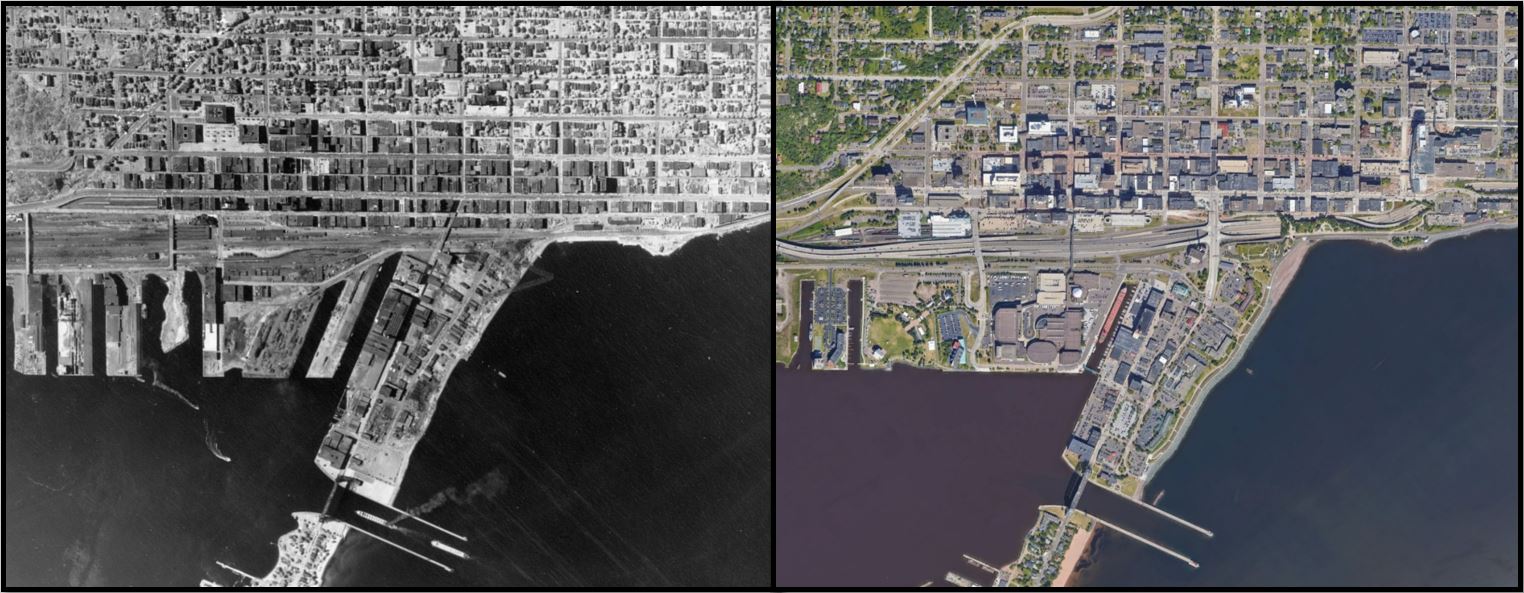
Duluth in 1948 and 2025. (Source: MHAPO and Google Earth)
The Ojibwe, holding sovereignty over the land, limited non-indigenous settlement to northeastern Minnesota prior to the signing of the Treaty of La Pointe in 1854. Following the transfer of most of the area to U.S. control, the head of the lakes saw a modest influx of settlers, leading to Duluth’s incorporation as a town in 1857. During the 1880s and 1890s, Duluth’s rail connections with the logging, shipping and iron industries led to a population boom. The city was even predicted to become bigger than Chicago. That didn’t happen, but even as logging declined, a combination of steel and manufacturing jobs kept Duluth’s population near 100,000 from the 1930s through 1970.
In 1971, U.S. Steel began shutting down parts of its local operations. The Curious Minnesota podcast notes that in the 1980s, Duluth lost its three largest employers: U.S. Steel, the Duluth Air Force Base and Jeno Paulucci’s frozen food plant. The resulting economic downturn dropped the population to its current level of around 87,000.
The fact that Duluth has maintained that population over the past four decades reflects a successful economic shift away from reliance on iron ore and steel and toward health care, education and tourism. Mayor Roger Reinert has set a goal of increasing the population to 90,000 by 2030 — reviving a target originally set by Mayor Don Ness in 2011 for the year 2020. The people of Reddit have differing opinions about whether growth in Duluth is possible — or even desirable. But if it does occur, it might be enough to keep Duluth just ahead of Bloomington in the Minnesota population rankings.
Bloomington
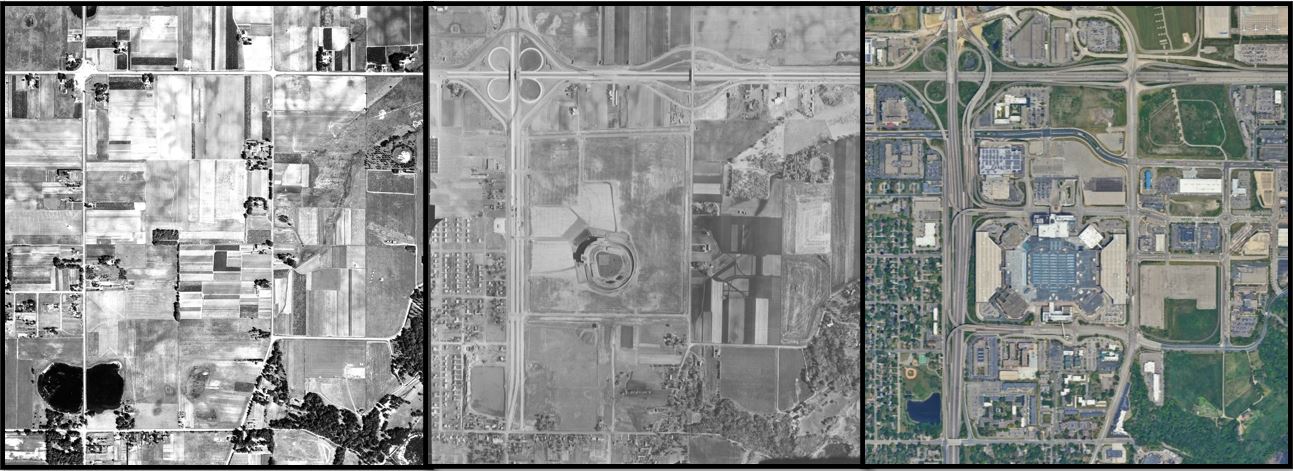
Northeast Bloomington in 1945, 1969 and 2025. (Source: MHAPO and Google Earth)
By census records, Bloomington’s reign as the third-largest city in Minnesota has been brief. In 1990, it took the title from Duluth with just 862 more people. Duluth reclaimed the designation in 2000 after a decade of slow growth in Duluth and slow decline in Bloomington, resulting in a lead by Duluth of 1,746 people. That Bloomington ever held the third-place spot at all is a bit remarkable.
While it is known as a Twin Cities commuter suburb, its settlement by non-Indigenous people predates Duluth. Three years before the Treaty of La Pointe, the Treaty of Traverse des Sioux created the legal framework that allowed families from Bloomington, Illinois, to move to the area, providing the name that the town would incorporate under on May 11, 1858 — the day Minnesota became a state. It wouldn’t incorporate as a city until more than 100 years later.
Bloomington remained a small farming community until highway construction and suburban expansion in the 1950s and 1960s brought its population from around 10,000 in 1950 to 50,000 in 1960, transforming it into a residential and commercial hub. Its population continued to grow as Twin Cities families moved to the suburbs, making it Minnesota’s third-largest city in 1990.
The plot of land shown above probably best encapsulates the development of Bloomington over the years. The aerial photo on the left shows a largely undeveloped section of farmland in 1945. The center photo shows Metropolitan Stadium, built in 1956. The Minnesota Twins played their first-ever game there on April 21, 1961. On Sept. 17 of that same year, the newly created Minnesota Vikings beat the Chicago Bears in their first NFL regular-season game, also at The Met. Originally built for minor league baseball, the stadium was considered one of the best in the minors when it opened. But when it closed down in 1982 — after years of piecemeal expansion and deferred maintenance — it was considered one of the worst stadiums in the major leagues. The Metrodome opened in Minneapolis that same year, and Met Stadium was demolished in 1985.
The stadium and its parking lots occupied a large swath of land, creating an opportunity to build the largest mall in the United States in 1992. You can still find one seat from Met Stadium at the exact spot where it was struck by a 520-foot home run hit by Harmon Killebrew on June 3, 1968. A plaque on the floor of the mall marks the location of home plate.
The transition from farmland to sports complex to mega-mall reflects Bloomington’s shift from isolated area, to land easily accessible from the cities, to a prominent suburb. While its mid-century growth was quite rapid, the population of Bloomington has remained relatively stable since the 1990s. The Mall of America, however, continues to grow. A $2 billion expansion that began in 2008 extended the mall out to the site of the former Met Center, where the Minnesota North Stars played their first hockey game in 1967. A water park with a retractable roof is expected to open in 2027.
Rochester
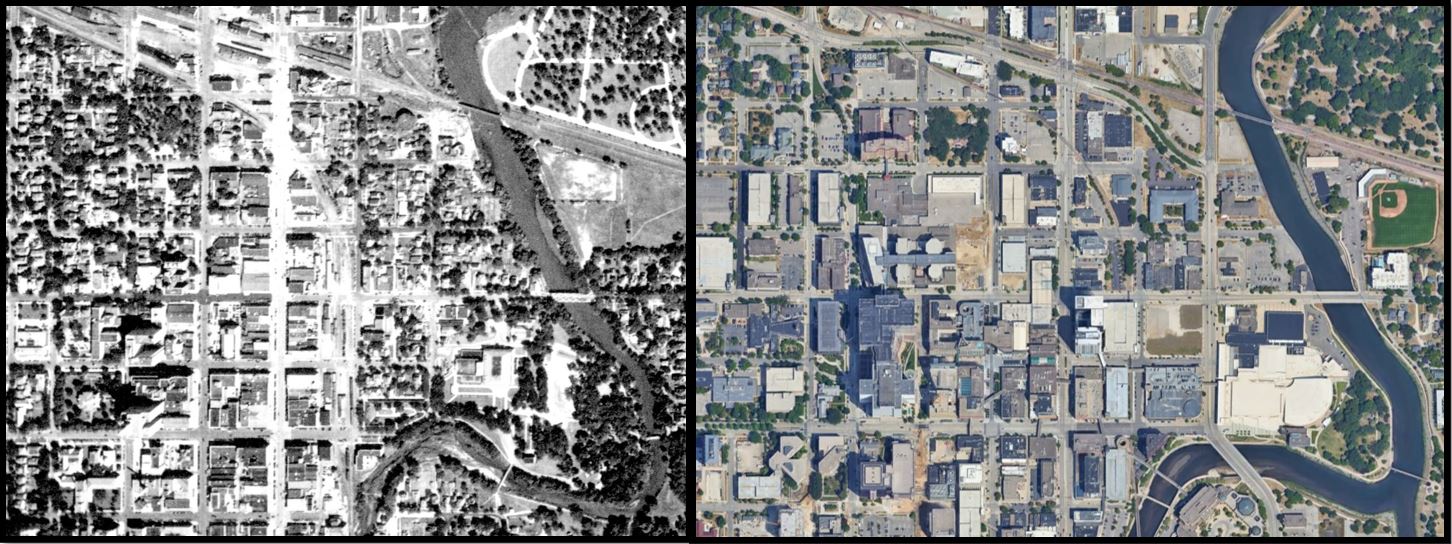
Downtown Rochester in 1949 and 2025. (Source: MHAPO and Google Earth)
Rochester has made irrelevant the question of whether Bloomington or Duluth will hold on to the title of third-largest city. The designation has now returned to what it was when Minnesota became a state. From 1860 to 1880, Rochester was the third-largest settlement in Minnesota. Between 1880 and 1890, it grew by just 200 people. During the same period, Duluth added 30,000 to its population. It would take 130 years for Rochester to regain the title of Minnesota’s third-largest city. In 2010, it gained 20,000 people during a decade in which Duluth’s population dropped by 4,000. Throughout the census records, Rochester’s population has never declined, steadily growing during both Duluth’s explosive growth and gradual population decline.
While the population histories of Duluth and Bloomington have been shaped by complex changes in industry, transportation and society, the story of Rochester’s growth is more straightforward. On Jan. 27, 1864, an advertisement in the Rochester City Post announced the opening of a private medical practice “over the Union Drug Store on Third Street” by William Worral Mayo, M.D. Today, the Mayo Clinic employs around 76,000 people.
Unlike many Midwestern cities that experienced industrial decline, Rochester has continued to expand due to the strength of its healthcare sector. In 1990, when Bloomington briefly held the title of third-largest city in Minnesota with a population of 86,000, Rochester trailed well behind Duluth with a population of 70,000. By 2020, with a population of 120,000, Rochester will likely remain the third-largest city in Minnesota for some time. With the Mayo Clinic’s continued growth, a thriving biotech industry, and new infrastructure projects, Rochester remains one of Minnesota’s fastest-growing cities and a key driver of the state’s economy.
While Duluth looks unlikely to regain the title of Minnesota’s third-largest city anytime soon, where it may end up on the list in the future remains an open question. Wikipedia’s 2023 city population estimates place Duluth in the #4 position, ahead of Bloomington by 282 people. Brooklyn Park, Woodbury, and Plymouth are all within 10,000. Twin Cities suburbs are, as always, on a trend to grow, and the next city down the list that isn’t a Twin Cities suburb is St. Cloud, at #12. The next nine after St. Cloud are also Twin Cities suburbs, followed by Mankato and Moorhead, and then another 15 suburban and exurban Twin Cities communities before Owatonna at #39.
In that sense, comparing Duluth’s size to a seemingly endless — and often difficult to differentiate — series of Twin Cities suburbs could be seen as a pointless exercise. The comparison with Rochester, however, might be more valuable: while continuous population growth may not be the goal, maintaining a stable employment base with the potential for long-term growth certainly is, regardless of which position Duluth holds on the list of Minnesota’s largest cities.
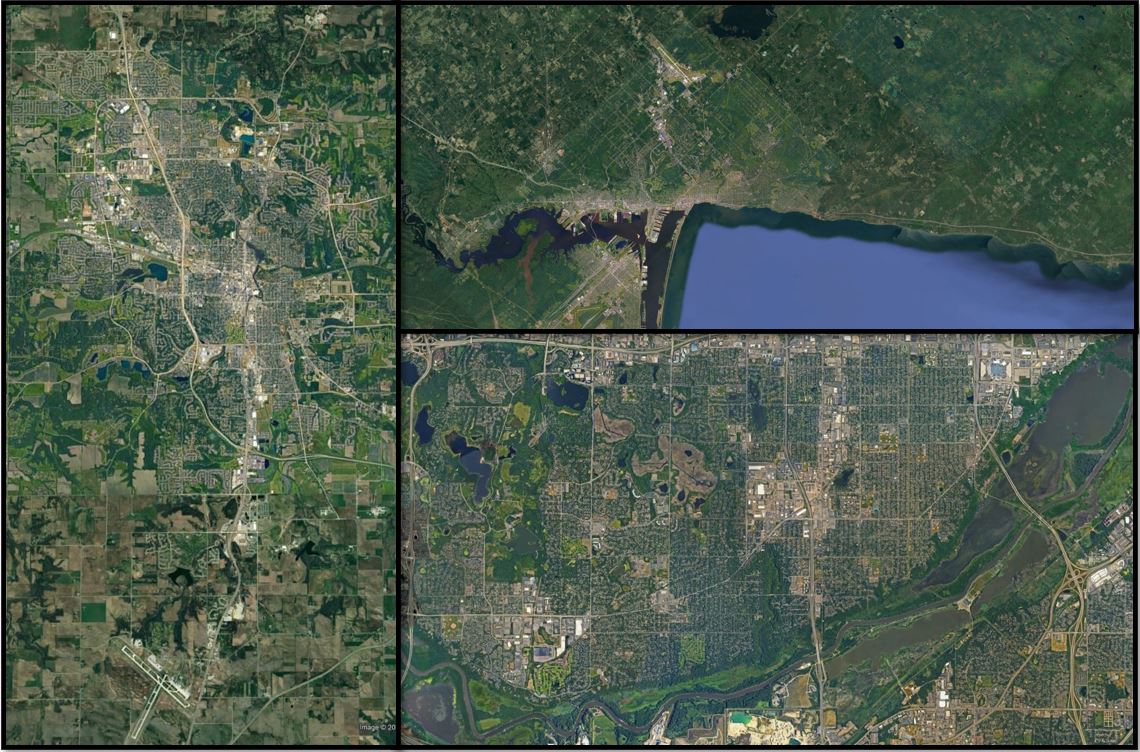
Rochester (left), Duluth (above) and Bloomington (below) in 2025. (Source: Google Earth)
This month’s Geoguessr challenge focuses on the similarities between Minnesota’s third, fourth and fifth largest cities, having rounds in similar looking neighborhoods across the three cities.
PDD Geoguessr: Duluth, Rochester, or Bloomington
A guide to playing Geoguessr can be found here.