

Duluth Deep Dive #11: When the Hollow Concrete-Block Building Boom Came to Duluth
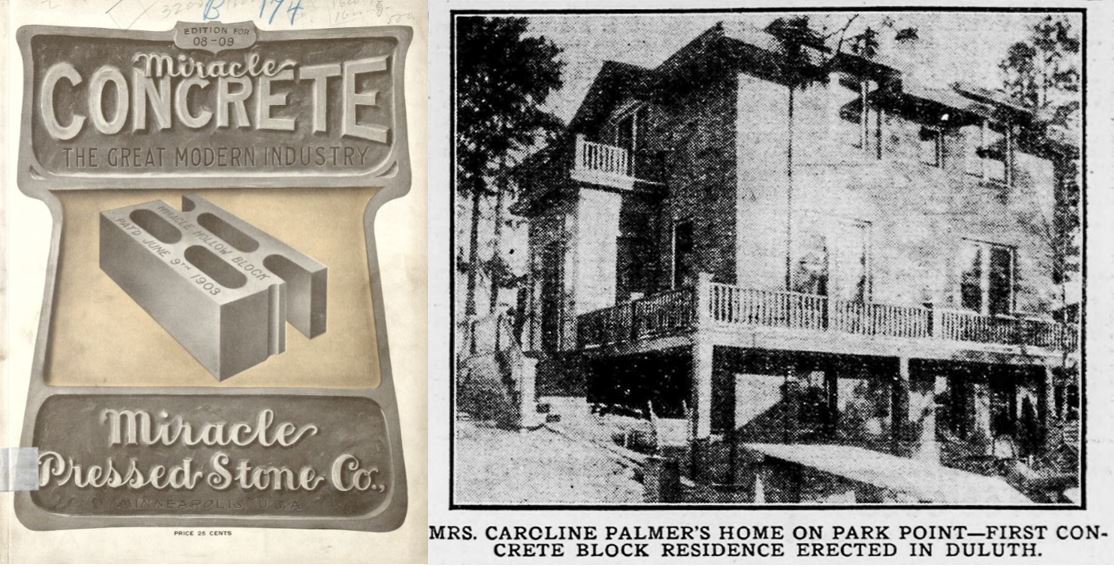
Left: Cover of the 1908 catalogue for the Miracle Pressed Stone Company of Minneapolis; Right: The first hollow concrete-block house in Duluth. (Sources: The Minnesota Digital Library; The Duluth Evening Herald, Feb. 3, 1906)
A few months ago a friend of mine from elementary school moved into a house on Park Point. When he asked me to help look into its history, we learned he had purchased the first hollow block concrete home ever built in Duluth, and one of the oldest still standing in Minnesota. This Duluth Deep Dive looks at the start of the hollow concrete-block building boom in Duluth and where it led. It describes the links between local concrete homes and the Duluth shipping canal. It also challenges the claim that Duluth had the first concrete streets in Minnesota.
The discovery that my friend had purchased a house with a particular significance came rather late into learning about its history. Searching for the address in the Minnesota Digital Newspaper Hub led to previous owners and searching for previous owners led to stories related to his home: a sergeant who died in World War I;[i] a son who drove out onto Lake Superior with friends to tow a truck off thin lake ice and crashed through the ice himself — he survived but his three friends in the back seat drowned;[ii] the home serving as a meeting spot for the Ladies’ Aid Society of the First Norwegian-Danish Methodist Church;[iii] and a large Halloween party in the early 1920s.[iv] These notes about previous owners eventually led to an article about the woman who had the house built, Caroline Palmer, with the rather choppy headline, “Concrete Blocks — Residence Now Being Built of Them on Park Point. — If It Proves Popular, May be Manufactured on Large Scale.”[v] The architect of this new home was E.S. Radcliffe, who lived two doors down at the time.[vi]

Left: An article from the Duluth Evening Herald on Aug. 23, 1904 about the first concrete residence in Duluth; Top: A photo of the home from the Duluth Evening Herald, Feb. 3, 1906; Bottom: A photo by Matthew James of the home in August 2025.
Concrete as a building material dates back as far as 200 BCE when it was invented by the Romans, but its production and use vanished with the fall of the Roman Empire in the fifth century. In 1824, an English stonemason developed Portland cement, allowing for the production of stronger and more durable concrete and returning its use to the modern era. The first concrete building came to Duluth in 1883. Camille Poirier, the entrepreneur who patented the original Duluth Pack, built his shoe store on Lake Avenue and Superior Street out of solid concrete blocks. When it caught fire three years later, the intensity of the heat ruined the blocks and the building was torn down and replaced with a brick structure. The fragility of Poirier’s building came from its experimental nature.
In 1900, Harold S. Palmer fundamentally changed how concrete was used in construction when he invented and patented a concrete-block machine that could produce uniform hollow concrete blocks. Palmer’s machine created a new way of building with concrete that generated quite a bit of excitement, but few homes made with the new process actually went up. The building boom for the use of concrete blocks did not happen until four years later when the 1904 St. Louis World’s Fair popularized the use of hollow concrete blocks.[vii]
At the St. Louis Fair, 40 different cement manufacturers came together in a building constructed of reinforced concrete to demonstrate to the public the many advantages of building with concrete. The exhibit featured not only multiple different hollow block construction devices but complete documentation on the use of concrete from raw materials to finished product. It also included a testing laboratory where people from the industry themselves experimented with new ideas. The exhibit led to national organizations of concrete-block manufacturing, including the National Association of Cement Users that set standards and established best practices.[viii]
The St. Louis Expo marked the moment when concrete-block construction became known in the United States to architects, academics, builders, and the general public. The master’s thesis by James P. Hall that provided much of the concrete history for this Deep Dive quotes a 1907 Engineering Journal that credited the Expo for popularizing the cement block machine:
The cement block machine has preempted the ‘territory from the Atlantic to the Pacific and from the Lakes to the Gulf.’ The exhibits made at the St. Louis Exposition in 1904 gave the people some idea of the magnitude of this new industry, and in my humble opinion did more to break down the prejudice of the devotees of the “old system” than anything that has occurred.[ix]
The cement manufacture’s exhibit wasn’t the only place to see concrete construction techniques at the fair. The Minnesota Building at the St. Louis World’s Fair was also made out of hollow concrete blocks.[x] It was designed to be easily taken apart so that after the exposition ended in St. Louis, it could be reassembled and cemented permanently in place on the Minnesota State Fairgrounds.[xi]
The St. Louis World’s Fair lasted from April 30 to Dec. 1, 1904. There is no evidence to suggest that Radcliffe went to the fair himself, but it is worth noting that whether or not Radcliffe knew of the concrete exhibition or had any awareness of the Minnesota Building, his concrete-block home on Park Point went up right in the middle of the fair. The Duluth Evening Herald reported a building permit being issued for Palmer’s concrete-block home on Aug. 23, 1904, making it not only the first hollow concrete block home in Duluth but possibly one of the earliest concrete-block homes in Minnesota.
The first known permits for concrete homes in Minnesota were issued in Minneapolis on June 12, 1904 and June 22, 1904, for homes at 3247 Calhoun Boulevard and 715 Plymouth Ave., respectively.[xii] No houses currently exist on either site. The only other 1904 permit described as being issued for a concrete-block home in Minneapolis appeared on July 26, 1904, four weeks before the permit for the Radcliffe’s Park Point home.[xiii] The home was built by Oliver Nolan, who patented his own concrete-block device in 1902.[xiv]
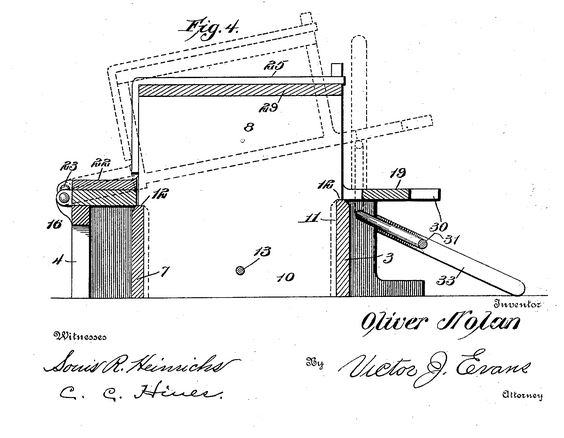
Oliver Nolan’s 1902 patent for a concrete-block mold. (Source: U.S Patent Office located using the historical patent dataset. Petralia, Sergio; Balland, Pierre-Alexandre; Rigby, David, 2016, “HistPat Dataset,” https://doi.org/10.7910/DVN/BPC15W, Harvard Dataverse, V8)
The home that Nolan built is still standing at 1811 E. 28th St. and might be the oldest surviving hollow concrete-block home in the state. Or it might not. First, if he used his own patented device in the construction, the home is made of solid concrete blocks. Second, the Streetview image shows, and the 1912 Minneapolis Sanborn Fire Insurance Map confirms, that the first floor of the neighboring house is made of concrete blocks with the second story using traditional frame house construction (in the map, shown below, D stands for “Dwelling,” C.B. stands for “concrete block,” F stands for “frame house,” and A stands for “auto,” meaning a garage). The Hennepin County database shows this house as having been built in 1903. Either the two homes, which have very different designs and clearly use different types of concrete blocks, have some unknown connection to each other, or far more concrete-block homes went up between 1900 and 1904 than the building permit records in the newspaper archives show. The Minneapolis Tribune published newly passed regulations for building homes with concrete blocks on July 15, 1903, which strongly suggests that enough of them were being built at the time, and likely not to adequate standards, for someone to push for their regulation. And Minneapolis was likely not the only city experimenting with hollow concrete-block home construction before 1904. The Grand Rapids Herald-Review states that Bemidji constructed several concrete-block houses in 1903, but provides no specific information on their location to verify if they were actually built or still exist.[xv] Further, while the St. Louis World’s Fair may have popularized hollow concrete-block construction, the fact that Minnesota chose a hollow concrete-block structure for the fair itself and papers across the state wrote about the choice extensively prior to the fair,[xvi] suggests experiments with the material in Minnesota were already well under way. The location of the actual oldest hollow concrete-block house in Minnesota therefore likely remains unknown.

Either the two oldest concrete-block homes in Minnesota are right next to each other or these are not the two oldest concrete-block homes in Minnesota. (Photo by Matthew James; 1912 Sanborn Map from the Library of Congress)
The oldest hollow concrete-block home in Duluth is pretty clear. The novelty of Edwin Radcliffe’s new house was expressed by the Duluth Evening Herald on Aug. 23, 1904, the same day Radcliffe’s permit was issued:
The experiment is being watched with much interest by local contractors and builders. Up to the present time no person has been willing to try the experiment with the concrete blocks in Duluth. There are no less than three firms in the city who are engaged in the business of making and selling the blocks, but up to the present time they have been unable to find a market in the city. They have all signified their willingness to go into the manufacturing of the blocks extensively if a market can be found for them, and should the experiment on the residence of Mrs. Palmer prove successful another industry may be added to the growing list of Duluth’s manufacturing establishments.[xvii]
It didn’t take long for other concrete structures to come to Duluth. In September, the city issued a building permit for a concrete-block store on Park Point, on Lake Avenue and Eighth Avenue West, just across the canal.[xviii] And that same month, a call went out to contractors for Duluth’s first major concrete building: a new county poor house to replace structures built by Radcliffe himself in 1899.[xix]
The Duluth Evening Herald reported:
The construction of a building of this character of concrete blocks will be watched with a great deal of interest … because structures of this kind are as yet somewhat a novelty in this part of the Northwest. The use of the concrete block for general building is making great strides and will undoubtedly come into still greater use next season, if the present winter does not reveal any flaws of consequence in the article.[xx]

The new concrete-block poorhouse. (Source: Duluth Evening Herald, Oct. 28, 1905)
The Evening Herald predicted the building would be “one of the most substantially built and longest lived structures ever built in the Northwest.”[xxi] It was razed in 1987 and newer St. Louis County government buildings now occupy the site, with the only remaining signs of the area’s former use as a poorhouse being the barn from the adjacent poor farm and a nearby cemetery containing the unmarked graves of former poorhouse residents.
In October 1904, a Duluth Evening Herald article, noting both the new county poor house and the home on Park Point, described the growing interest in Duluth for concrete as a building material. It had some doubts about the plans to construct houses using concrete. The article noted its advantages in terms of insulation, fire resistance and durability, but questioned if these would prove true in Duluth’s harsh winter climate.[xxii]
They returned to the subject a year later, noting that “one small house of concrete blocks,” the house designed by Edwin Radcliffe, had been completed on Park Point and that there were plans for others nearby. In the East End, architect Arthur Terryberry had completed plans for the largest concrete house in Duluth yet.[xxiii] While an earlier article contained a drawing of the home, no address was provided and it is unclear if the home was ever built.

Drawing of Arthur Terryberry’s East Duluth concrete-block home, which may or may not have been built and may or may not still exist. (Source: Duluth Evening Herald, Dec. 17, 1904)
Local builders began debating whether or not a city concrete inspector might be necessary to ensure new buildings met certain quality standards[xxiv] as new concrete-block homes continued to go up, with four announced for West Duluth by the end of 1905.[xxv] On March 28, 1905, a day after the formal completion of the new ferry bridge across the Duluth harbor, plans were filed for “two small waiting rooms constructed of concrete blocks with an ornamental red roof.” The plans were accompanied by an offer to construct them for free in exchange for the rights to sell candy and cigars from them to those waiting to cross the canal.[xxvi]
In 1906, a Duluth bricklayer working as his own architect, contractor and builder, constructed a house of brick and concrete blocks for himself. He did all of the building himself with the exception of the roof, which he claimed he could also have done on his own but he became worried about being finished before winter.[xxvii] His house still stands at 2407 E. Third St.. Proctor got its first concrete-block building in 1906 with a home at the corner of First Avenue and Third Street across from the Catholic Church. [xxviii] Neither the home nor the church are still standing.
The Duluth Herald suggested that Duluth’s trust in the use of concrete could be attributed to the attention generated by the construction of the Duluth Ship Canal.[xxix] When the U.S. government purchased 9,000 barrels of Portland cement for reconstruction of the canal in 1900,[xxx] it was the first time that concrete had been chosen over limestone for a U.S. government pier project. All of the government’s pier construction work across the country in the years after the Duluth shipping canal used concrete.[xxxi]
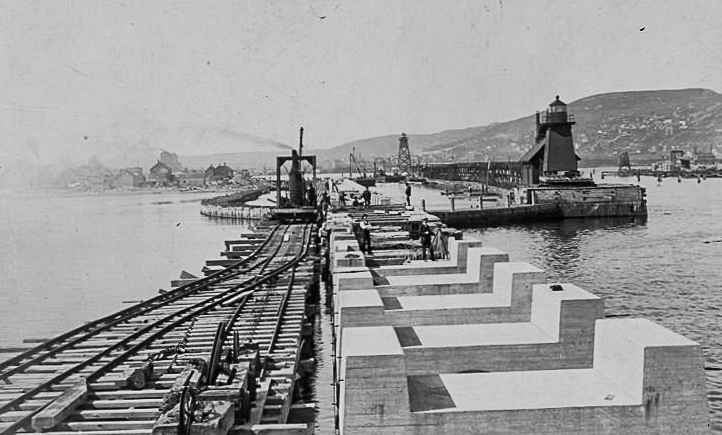
Construction of the Duluth shipping canal piers, August 1900. (Source: The Minnesota Digital Library)
The Duluth pier concrete was not standard Portland cement but mixed with the trap rock found throughout Duluth. Specifically, the project used rock taken from a lot that government had purchased on Superior Street and Eighth Avenue West.[xxxii] Mixing the rock with the cement made the resulting concrete harder than the rock itself. The project was still an experimental one and people had concerns after it was built. Concrete flakes chipping off corners of the blocks suggested the material was not as durable as promised. A government engineer explained that concrete blocks had been placed on a wooden structure that had a small amount of give to it. When laying the blocks, this movement was not adequately accounted for, resulting in the blocks being spaced too close together, separated only by small point of felt. When heavy waves put extra pressure on the underlying wood structure, the corners of the concrete blocks would grind against each other, resulting in flaking of the concrete. This damage, the engineer explained, was cosmetic, not structural.[xxxiii]
The first major test of the new concrete structure came five years later when the S.S. Mataafa wrecked in the Duluth Ship Canal during a fierce storm in November 1905. The Lake Superior tragedy cost the lives of nine men. The ship crashed its massive weight, heavier than the pier head itself, into both the north and south pier. The steamer struck the north pier directly, bow first, creating an inch-deep, foot-wide scar 12 feet down from the top of the wall. It did not, however, do any structural damage to the wall, proving that concrete could withstand both major weather events and the battering of a ship far larger than those in use at the time of the pier’s creation.[xxxiv]
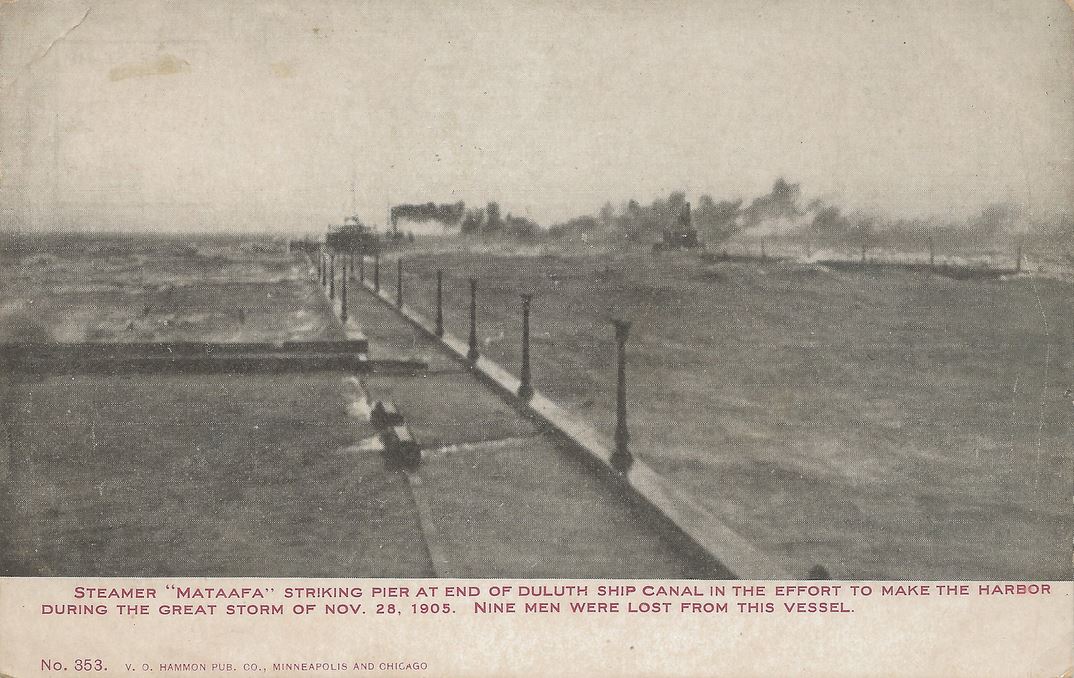
Postcard showing the Mataafa crashing into the Duluth shipping canal pier. (Source: Don Harrison, Flickr)
The concrete piers of the Superior entry went up the same summer that Edwin Radcliffe built the first concrete home on Park Point, and they were also a massive project. The Duluth Evening Herald reported on June 2, 1904 that 1,500,000 pounds of material were being deposited daily for the construction of the new piers. The engineer in charge of the work was a bit annoyed at the lack of public understanding of the process. In response to a newspaper article talking about transporting the concrete blocks to the site before lowering them into the water, he stated:
Any one acquainted with the nature of pier work, at all, will be very much astonished to learn that there are any scows or derricks strong enough to handle concrete blocks that weigh hundreds of tons. The fact of the matter is the concrete is being laid under water, the big molds being first placed and then filled with the concrete transported from the mixing plant and lowered a bucketful at a time. The traveler with its hoisting apparatus has been tested to handle 10 tons, but when it comes to talking about handling one of the immense monolithic blocks with a hoisting apparatus, especially one on a scow, the statement appears absurd.
It might be well for those who desire to make public statements of the work now under progress to visit the entry and see how the work is being done before attempting to describe something they know nothing about.[xxxv]
While Radcliffe likely did not attend the St. Louis Word’s Fair, as a Park Point resident he likely did have some knowledge of the two massive concrete projects that went up within a few years of each other on either side of his home. At the very least, the massive amounts of concrete used by the two projects fueled the market for local production.[xxxvi]
A 1902 editorial in the Duluth Evening Herald suggested using concrete for street paving[xxxvii] but it took until 1909 for Duluth to construct concrete streets. These are considered the first concrete streets in Minnesota, but this claim is called into question by reports in the Duluth Evening Herald from 1907 that Akeley, Minnesota, was rebuilding both the sidewalks and roads[xxxviii] of its major streets with concrete blocks designed to “give Akeley an especial good appearance.”[xxxix] While parts of the concrete sidewalks seem to still be in place, the streets have been repaved with asphalt, leaving the city’s only remaining claim to fame as having the world’s largest Paul Bunyan statue. Therefore whether or not Duluth’s concrete streets were the first, they are the oldest still remaining.

The plaque describing the first concrete street in Minnesota being built in Duluth in 1909 and the newspaper article announcing the construction of concrete streets in Akeley, Minnesota, in 1907. (Photo by Matthew James; article from the Duluth Evening Herald, June 23, 1907)
While the use of concrete as a building material increased, skepticism remained. In 1906, the Duluth Evening Herald challenged the idea that concrete was as fireproof or as durable as many claimed. It also noted “the criticism that has thus far been made against concrete blocks does not seem to have had the effect of lessening the demand and the prospect is that Duluth will have a great deal of that sort of building next year … One of the local experts in concrete work recently remarked that in years to come the ‘Stone Age’ of ancient history will give way in importance to the ‘Cement Age’ of the twentieth century.”[xl] A 1906 report on Radcliffe’s concrete Park Point home noted, “That it is a success is the general sentiment of all that have had an opportunity of examining the new building.”[xli] Later that same year, the Duluth Evening Herald reported that building with concrete was proving not as cheap as predicted, with both material and labor costs going up, but they saw this as a positive development, as those building with concrete just to keep costs as low as possible were giving the material a poor reputation through substandard construction practices.[xlii]
In North America, the concrete building boom lasted between 1904 and 1910. But for Duluth, the peak came a bit later. The first operational buildings of the steel plant at Morgan Park were the concrete factories. In 1910, the steel plant built two concrete plants, one for foundation work and another for concrete blocks to build nearly all of the plant buildings and the Morgan Park homes for many of the workers.[xliii]

U.S. Steel Concrete Factory, 1910. (Source: Duluth Herald, July 23, 1910)
Starting from Radcliffe’s single small experimental home on Park Point, Duluth’s concrete-block construction boom ended with the development of an entire neighborhood. In 1922, Morgan Park added a Protestant church made entirely out of concrete blocks. In 2024, it was added to the National Register of Historic Places. The only other active Duluth church on the registry is St. Mark’s African Methodist Episcopal Church, designed by Edwin Radcliffe.
By the 1930s, far fewer builders were choosing to work with concrete as the material began to have negative associations that persist to this day.[xliv] A concrete inspector may have been a good idea, because during the boom period, many builders worked with poor equipment and inadequate understanding of how to work with the material. As noted in Hall’s thesis, the resulting low-quality buildings led to a general distrust of building with concrete.
Radcliffe’s first concrete house in Duluth seems to be an exception to this trend, as it remains standing and in good condition, a marker to the beginning of a short-lived building trend that, with the construction of Morgan Park, had a far longer lasting affect in Duluth than most other cities.
This month’s Geoguessr challenge visits five of the concrete associated locations described in the post. Each round lasts five minutes.
Geoguessr Challenge: The Hollow Concrete Block Building Boom in Duluth
A guide to playing Geoguessr can be found here.
Notes
[i] Duluth Herald, March 13, 1918, Oct. 2, 1920
[ii] Duluth Herald, Feb. 2, 1931
[iii] Duluth Herald, Aug. 20, 1919
[iv] Duluth Herald, Nov. 5, 1921
[v] Duluth Evening Herald, Aug. 23, 1904
[vi] Duluth Evening Herald, July 3, 1909
[vii] Hall, J. P. (2009). The Early Developmental History of Concrete Block in America.
[viii] Hall, J. P. (2009). The Early Developmental History of Concrete Block in America.
[ix] Hall, J. P. (2009). The Early Developmental History of Concrete Block in America.
[x] Wilmar Tribune, Aug. 10, 1904
[xi] The Saint Paul Globe, June 18, 1903
[xii] The Minneapolis Tribune, June 12, 1904; The Minneapolis Journal, June 22, 1904
[xiii] The Minneapolis Journal, July 26, 1904
[xiv] The Minneapolis Journal, Oct. 11, 1902
[xv] Grand Rapids Herald Review, Oct. 22, 1904
[xvi] Wabasha County Herald, June 25, 1903; Harmony News, June 25, 1903; The Saint Paul Globe, June 18, 1903
[xvii] Duluth Evening Herald, Aug. 23, 1904
[xviii] Duluth Evening Herald, Sept. 23, 1904
[xix] Duluth Evening Herald, June 19, 1899; Oct. 20, 1899; Sept. 30, 1904
[xx] Duluth Evening Herald, Jan. 21, 1905
[xxi] Duluth Evening Herald, Dec. 15, 1904
[xxii] Duluth Herald, Oct. 21, 1904
[xxiii] Duluth Evening Herald, March 10, 1905
[xxiv] Duluth Evening Herald, May 2, 1905
[xxv] Duluth Evening Herald, Sept. 21, 1905; Oct. 10, 1905
[xxvi] Duluth Evening Herald, March 28, 1905
[xxvii] Duluth Evening Herald, Sept. 30, 1906
[xxviii] Duluth Evening Herald, July 14, 1906
[xxix] Duluth Evening Herald, July 14, 1906
[xxx] Duluth Evening Herald, Jan. 11, 1900
[xxxi] Duluth Evening Herald, Dec. 23, 1903
[xxxii] Duluth Evening Herald, Dec. 11, 1905
[xxxiii] Duluth Evening Herald, May 1, 1908
[xxxiv] Duluth Evening Herald, Dec. 5, 1905
[xxxv] Duluth Evening Herald, July 13, 1904
[xxxvi] Duluth Evening Herald, Jan. 20, 1904
[xxxvii] Duluth Evening Herald, May 10, 1902
[xxxviii] Duluth Evening Herald, Sept. 8, 1907
[xxxix] Duluth Evening Herald, June 23, 1907
[xl] Duluth Evening Herald, July 14, 1906
[xli] Duluth Evening Herald, Feb. 3, 1906
[xlii] Duluth Evening Herald, June 6, 1906
[xliii] Duluth Herald, July 23, 1910; Aug. 17, 1911
[xliv] Hall, J. P. (2009). The Early Developmental History of Concrete Block in America.