

A View from Montreal Pier: The R/V Blue Heron
 Not long after I disembarked from the research vessel Blue Heron in June, it was announced that a new form of life had been discovered inside the propeller shaft. A life form, hidden inside the extreme environment of the engine, cold and dark — it feels like how the Venom movies started. It feels maybe a little Lovecraftian, maybe, this shapeless life form, in the black goo.
My colleagues laugh at me for thinking in such melodramatic terms. But really, ever since that ride, I just keep learning how cripplingly limited my understanding of Lake Superior, and of our relationship to it, really was. I’m still trying to wrap my brain around it.
Finding the Blue Heron
The Blue Heron is docked in Superior on Montreal Pier, a research facility maintained by the University of Wisconsin-Superior. The site itself is a weird mishmash of history. The Montreal Pier, Quebec Pier and Allouez Bay are all a reminder of the deep affect French Jesuits and fur traders had on the Superior region.
By the early twentieth century, these piers were incredible sites of commerce. Superior was in competition with the Minneapolis area as the center of wheat and grain production, and several major companies built grain elevators and mills on the piers — Lake Superior Mills, Anchor, Listman, Cargill, and Belt Line. Most of these structures were destroyed in fires.
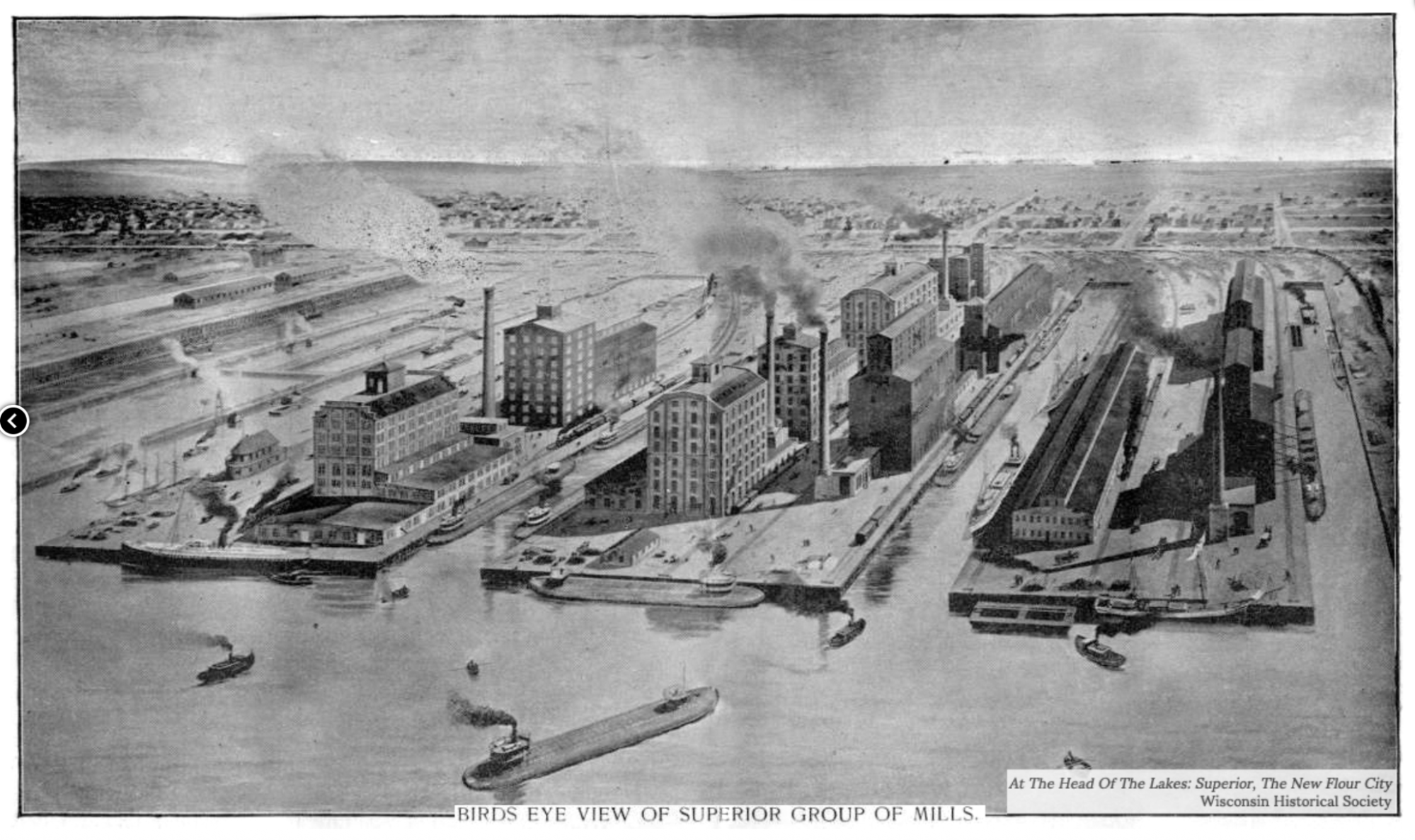
Historical postcard of the Montreal, Quebec and Toledo Piers at the height of industry. (Image from the Wisconsin Historical Society via the History Handbook website.
The consequences of that high level of industrial use, in a time before federal environmental regulations protected the lake, was environmental degradation. Contaminants came from multiple sources, not just the mills, including Murphy Oil. Hog Island, the site of a significant amount of environmental remediation, is adjacent to the piers where the Blue Heron is docked.
As I drove my little Kia from Highway 53 by the Super One, down the gravel roads, over the railroad tracks, I wasn’t just risking my car’s suspension on the potholes. I was in a way passing through history, a history in which the lakes were once a highway, bringing fur traders and missionaries into our region, bringing grain from our region to the world. And, regrettably, I was passing through a history in which the lakes were our waste disposal system, when we imagined that we could flush our industrial waste into the lake.
We imagined the lake to serve that function until the 1950s, when the U.S. Army and Honeywell were still dumping 1,400 barrels of munitions waste into the lake. Honestly, in a way, we were still imagining the lake that way into the 1970s, if you consider the scrapyard that used to be Duluth’s Canal Park.
But today, we see the lake differently, and one of the ways we see it differently is from the deck of the Blue Heron.
Boarding the Blue Heron
The Blue Heron is “the largest U.S. Academic Research Fleet vessel in the Great Lakes.” It was built in 1985 for fishing on the Grand Banks, an area off the coast of Newfoundland. The Grand Banks is a far richer fishery than Lake Superior (filled with cod, swordfish, haddock and capelin, a fish that resembles our own smelt).
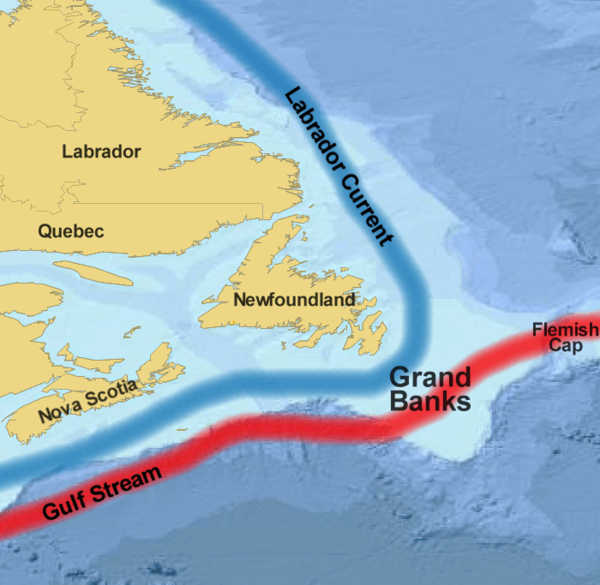
Map of the Grand Banks, off the coast of Newfoundland. (Image via Wikipedia)
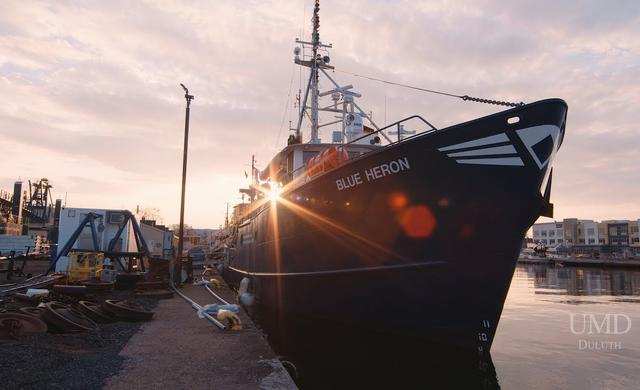
The Research Vessel Blue Heron. (Photo courtesy of the University of Minnesota Duluth)
When I boarded just after 6 a.m. on a chill Friday morning, the deck was still frozen — it’s easy to forget how cold it can get, right on the lake. Within a few minutes we had signed the waivers indicating that our safety was, as much as possible, our own lookout. I would later learn that I would need my hard hat as much as my lifejacket.
At breakfast on the boat, I would learn about the research we were on the lake to do.
Weather In and On the Lake
Professor Jay Austin maintains instruments (e.g., buoys) in Lake Superior that collect temperature, current, and meteorological data. According to Austin, his lab studies phenomena such as the role of ice and the effects of climate change on lake systems. In addition, according to the UMD website, “the lab provides students with hands-on experience in oceanographic fieldwork and data analysis.”
There were undergraduate and graduate students on board to help with this project, in which one of the buoys needed to be brought in for repairs.
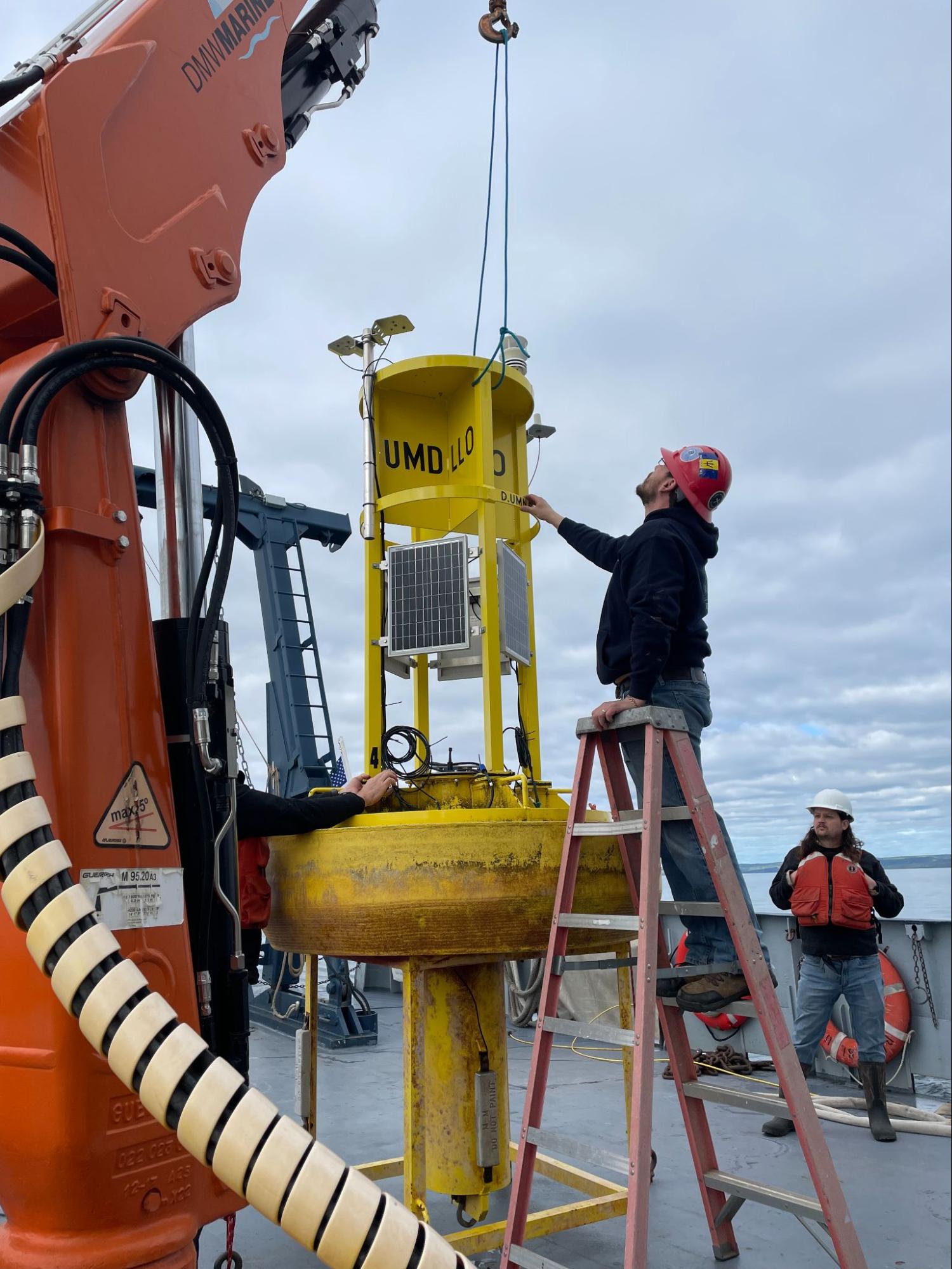
The crew of the Blue Heron lowers a high-tech buoy from Lake Superior onto the deck of the ship for an inspection. (Photo by David Beard).
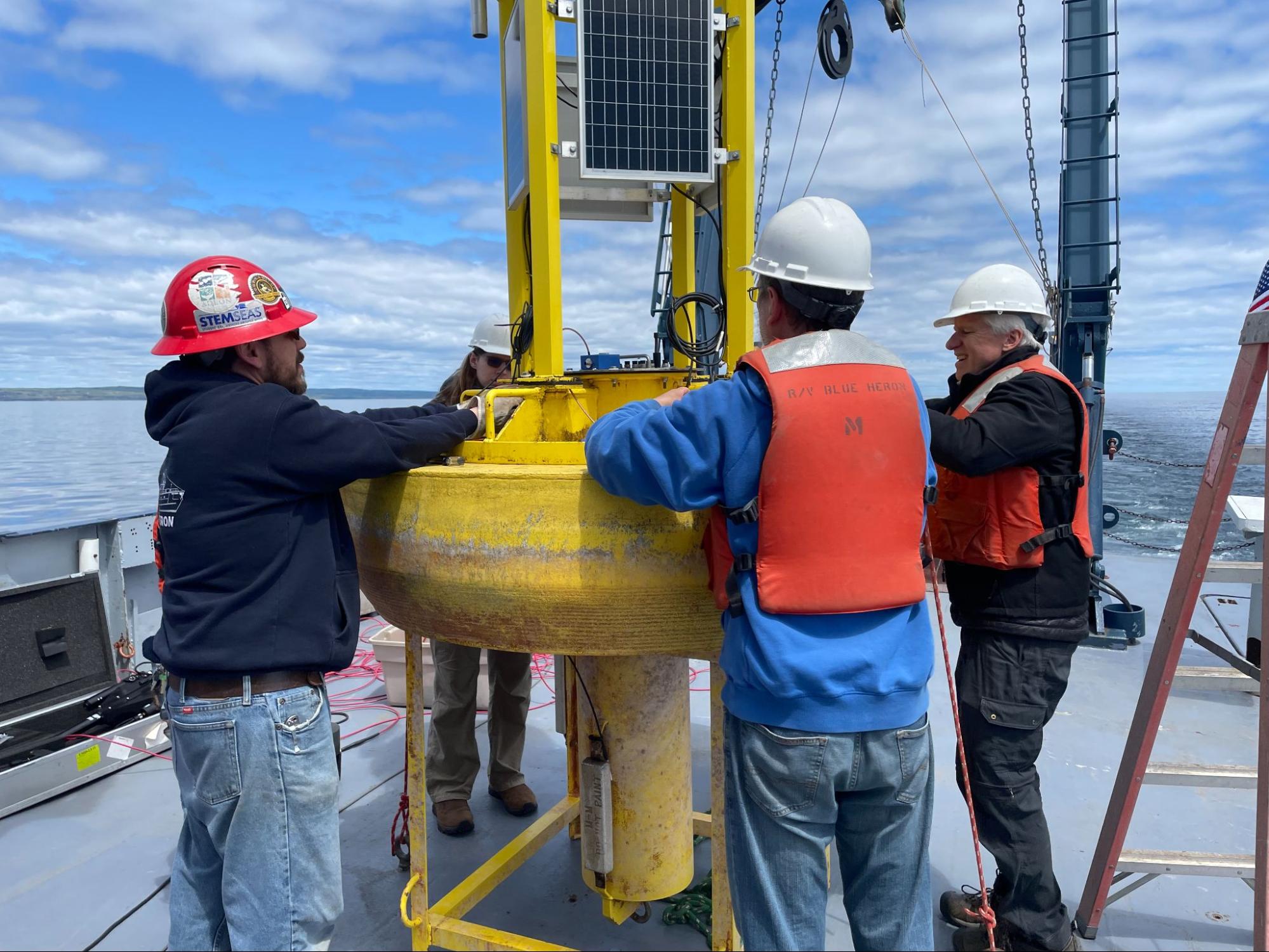
The students, faculty, and crew of the Blue Heron work quickly to remove the bolts holding the high-technology inner workings inside the buoy. (Photo by David Beard)
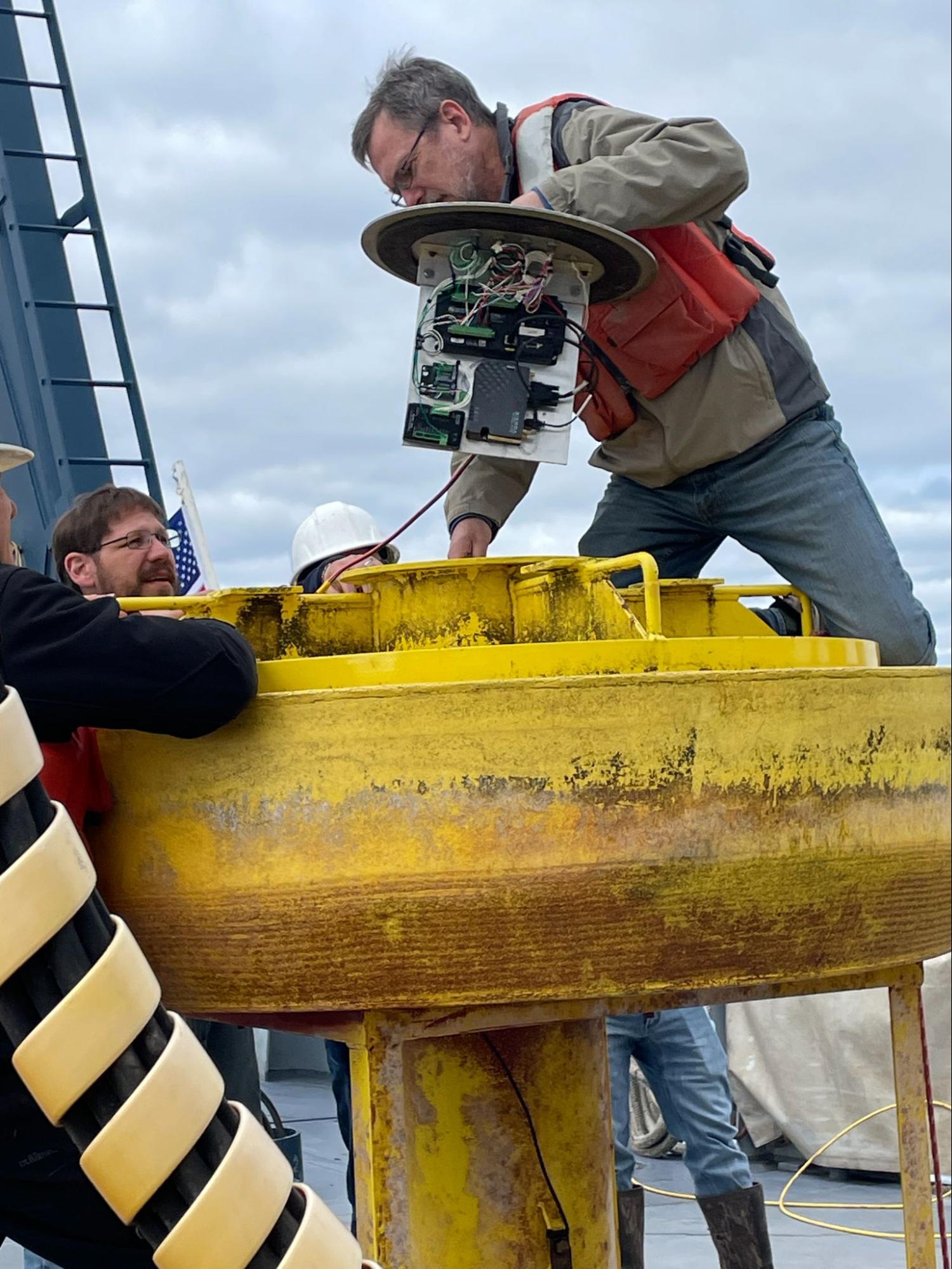
Jay Austin aboard the Blue Heron, Summer 2025, removing the high technology inner workings of a buoy designed to monitor weather and water in Lake Superior. (Photo by David Beard)
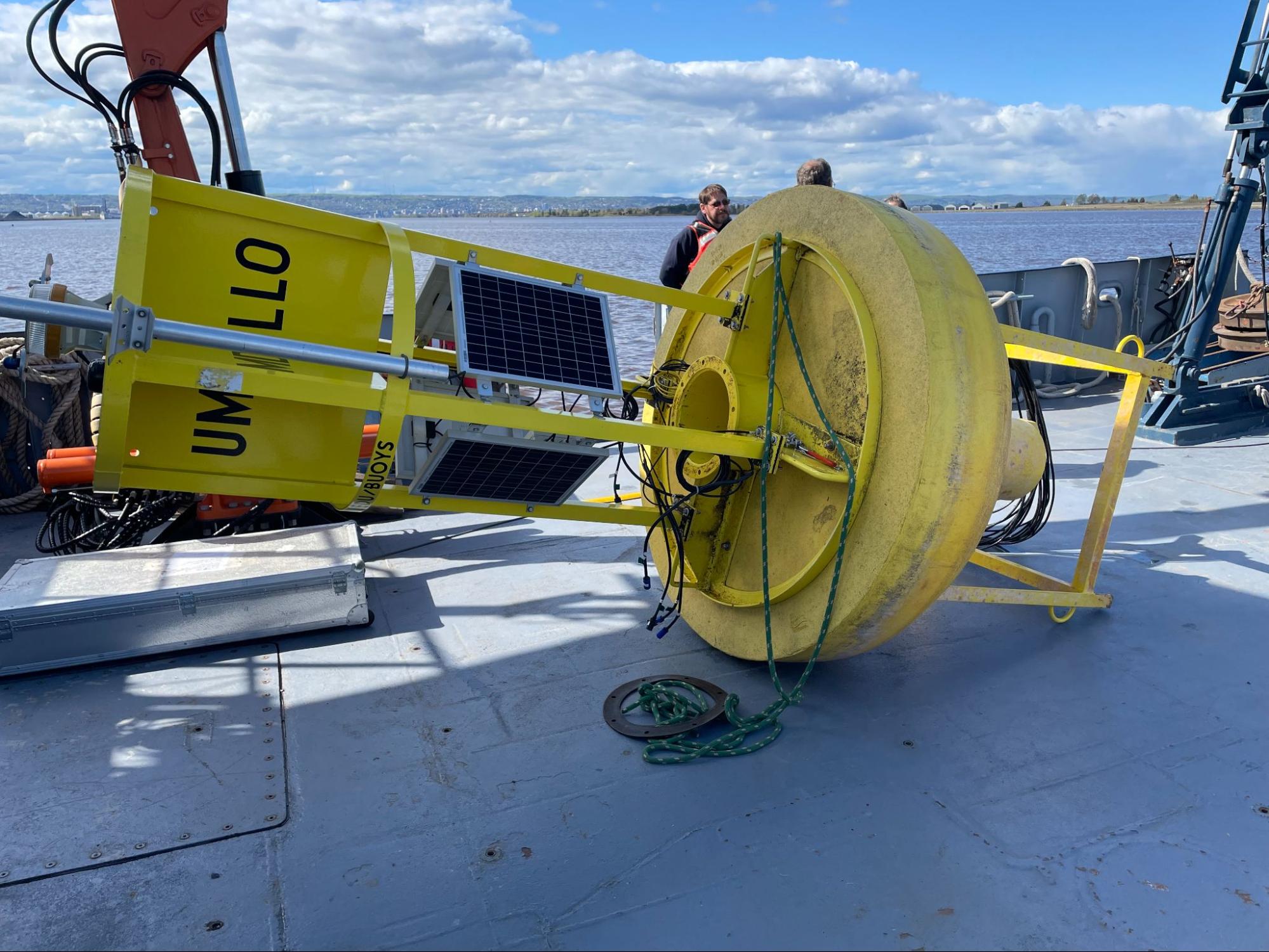
The buoy, it is determined, must go to shore for deeper repairs and replacement parts. (Photo by David Beard)
The buoys send data that is shared with the National Oceanic and Atmospheric Administration, and from there the data will inform weather apps around the world.
The buoys are part of the landscape of the lake, now, having been there for many years. Boaters and kayakers have come to expect the buoys as waypoints and markers on their adventures on the lake. As the federal government considers privatizing services offered by NOAA, I wonder what for-profit company would maintain buoys like these, or whether the links in the chain supported by NOAA and the university will fall away, and these buoys will fall into disrepair. I wonder whether our knowledge of weather and our ability to predict the worst of it will suffer. And I wonder whether our connection to the lake as an ecosystem will wither, too.
Neutrinos Passing Through the Lake
The university tries to maximize efficiency in operating the Blue Heron, so multiple research projects are booked on it each time it leaves the dock. On this trip, the Blue Heron was picking up the University of Minnesota’s long history of research on neutrinos.
That research included the old experiments in the Soudan Mine (closed up shop in 2016) and current experiments in Ash River. On this trip with the Blue Heron, Austin and his students were lowering sensors into the water to support a future deployment of instruments that will detect the ways that neutrinos are affected as they pass through the water.
In a sense, then, the lake is merely a medium through which subatomic particles pass. Of all the parts of this trip, this was the research that surprised me most, because the goal wasn’t to study the lake, at all.
Conclusion and Some Frustration
As a writer, and honestly, an occasionally maudlin and cliché writer, I was expecting to explore how we’ve moved from seeing the lake as a transportation system and a diluter of our waste into seeing it as an ecology. Had I joined the Blue Heron on a day when we were only tending buoys, I might have been able to convince myself of that. In my head, the story was an easy one. We moved from seeing the lake as a thing to be used into a space to be preserved and enjoyed.
The easy ending is never entirely accurate. Our relationship with the lake is in fact more complex than my oversimple narrative promised, because we do still use it as a roadway for our shipping. We use it to study neutrinos. We still use it as the receptacle for our waste — not as flagrantly as we did before, but human waste still makes its way into our beaches.
A few weeks after I disembark, new life, never before seen on Earth, would be announced as found on the propeller shaft, by accident, during routine maintenance in 2024.
The lake, and its scientists aboard the Blue Heron, will always surprise me with their discoveries, and our relationship with the lake will always be complex.