

The Way it Was in West Duluth
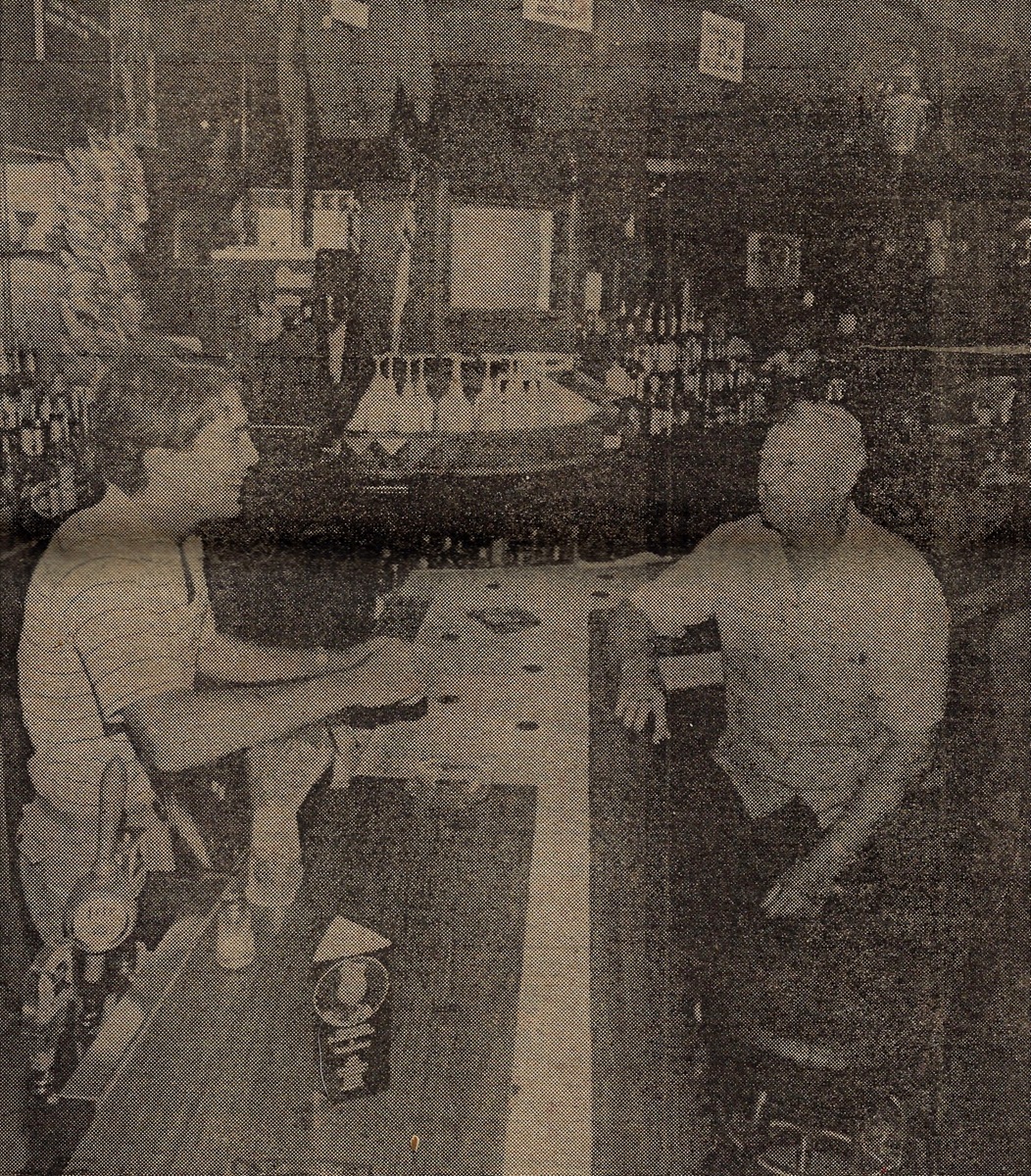
Alan Terway (left), bartender at Mr. D’s Spirit Valley Bar and Lounge, 5622 Grand Ave., talks with retired bartender Johnny Matheson of Superior. Matheson tended bar there in the 1940s and ’50s, when it was called Teve’s West Duluth Bar and Grill. (Duluth News Tribune & Herald photo by Charles Curtis, 1985)
And now, a look back at a look back. Forty years ago today — July 18, 1985 — the Duluth News-Tribune & Herald published a special Community Herald section with several stories about West Duluth. The cover story delved into neighborhood bar nostalgia.
The section was timed to coincide with the West Duluth Crazy Days Sidewalk Sale (July 19-20), which preceded the ninth annual Spirit Valley Days Festival (Aug. 8-9). Below is the complete text of the bar story, which focuses on the Kom-on-Inn, Rustic Tavern and Teve’s West Duluth Bar & Grill.
Bartenders recall the way it was in West Duluth
By Tom Dennis
Staff writer
Buck Kettner remembers.
“I had to bring three shirts a night to work, said Kettner, who’s been a bartender at the Rustic Tavern, 401 Central Ave. N., for nearly 20 years. “No kidding. They’d rip ’em off you as you were breaking up fights.”
Mary Crotty remembers.
“I’d be in here Friday morning to cash paychecks, and the line would be from here outside,” said Crotty, wife of the original owner of the Kom-on-Inn, 332 N. 57th Ave. W. “Twenty thousand dollars wouldn’t last very long in those days.”
There was a time when the now-abandoned factories in West Duluth were roaring around the clock, spewing out products and paychecks in a seemingly endless stream. For nightlife back then, West Duluth was the place to be.
Johnny Matheson remembers.
“I used to tell the other bartenders that we should pay … just to work there,” said Matheson, who worked at the now-defunct Teve’s West Duluth Bar and Grill in the ’40s and ’50s. “Jack Teter, Frankie Yankovic, The Ink Spots; oh, jeepers. The Westernaires — they were a girls’ group, just immaculate.
“Eight bartenders behind the bar at one time … It was a fabulous place, just fun, fun, fun.”
A glimpse of the glory days can be found on the walls of the Kom-on-Inn. The Inn opened shortly after Prohibition ended in 1933. It’s operated under the same liquor license ever since, a distinction is shares only with the Pickwick restaurant in downtown Duluth, Mary Crotty said.
Around the walls are a series of murals of the factories that once made West Duluth boom. The oil paintings were done by Art Fleming in the 1950s, and they’ve since been yellowed by varnish and time. But a visitor looking at them can imagine the bar teeming with backslaps, broad shoulders and beer. You can almost hear the factory whistle blow.
“This is all industry west of the ore docks,” Crotty said, pointing at the murals. “That’s the old brass works; Klearflax (Looms); that used to be a coffee company, Empress Coffee; Diamond Tool, of course that’s still here; Arrowhead Creamery …
“This has always been known as a workingman’s bar,” she said. Crotty gestured at the 25 customers. “Friday afternoons you couldn’t get a seat. Now look at it.”
It was and still is a well-behaved crowd at the Kom-on-Inn, Crotty said. A different crowd, apparently, than the one that gathered at the nearby Rustic Tavern.
“We called them the Friday Night Fights,” Kettner said. “Friday nights, a lot of fights. They were good guys then.” He smiled. “But tough.”
“Two guys would get into it; pretty soon, four, eight,” he said. “Tables broke, glasses, the whole bit … And (can you see) a skinny little guy like me, breaking up fights?
“Now, it’s a lot younger crowd. They’ve calmed down quite a bit; no squabbles. It would be a big thing now if there was a fight. Back then, it was nothing.”
The Rustic still does good business, especially since the place was remodeled some time ago, he said. “The kids have money to spend — I don’t know where they get it.”
But “you don’t find your real old-timers like you used to. It was a completely different crowd back then.”
You certainly didn’t find those “howdy-rowdies” at Teve’s, Matheson said. “You’d be surprised, for West Duluth — they had some rough boys out there. They had some men out there with muscle … But it (Teve’s) wasn’t a rowdy place. It was unusual if we had trouble.”
What Teve’s did have was a spanking-new stage. “The beauty of the new exterior sets you in the mood to be thrilled with the gorgeous interior in the modern Teve’s West Duluth Bar and Grill,” says a yellowed newspaper ad that probably dates to the 1940s.
Several name changes later, Teve’s is now Mr. D’s, 5622 Grand Ave. The stage is still there, but now it’s only used on St. Patrick’s Day for strip shows, an employee said.
But “it was really a rolling place in those days,” Matheson said. “They just had fabulous shows on that stage … When you had shows, you could fill the place every night.”
Families would come from as far as the Iron Range for the shows, he said.
“In those days, everybody was working,” he said. “Now, it’s just different. There’s money all right, but not the volume.”
Matheson, 70, knows his bars. “I tended bars for 45 years,” he said. “I started young. I worked nights, 3 or 4 in the afternoon until 1. It’s the people, the enjoyment … I like to meet people, see fresh faces. I could never go to a country bar, where you see the same thing every day. I’m more of an action man.”
In West Duluth, “I weathered the storm,” he said with a laugh.